
£1 Minimum Deposit Casinos in the UK: What to Know
 Available in GB
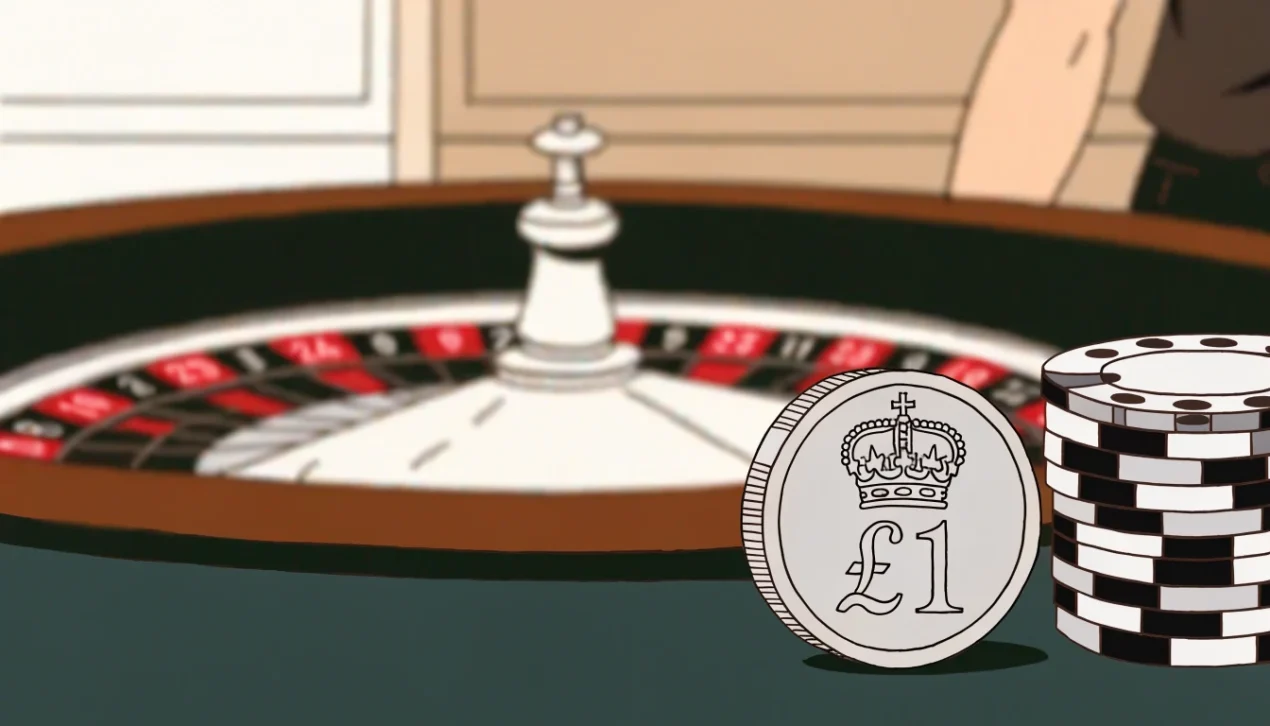
A £1 cashier threshold can differ from the amount needed for a promotion or from rules tied to a payment route.
What a £1 Minimum Deposit Actually Buys
A £1 minimum deposit is an entry point, not a promise of what follows. At some UK casinos, that amount is enough to put money into a real-money account. It does not, by itself, establish that every cashier option will accept the same sum, that a promotion will be available, or that the account can be used without completing the operator’s checks.
The distinction is simple but consequential: depositing funds and qualifying for an offer are separate decisions. The cashier sets the conditions for putting money into an account. A promotion has its own terms, which may set a different qualifying deposit. A site can therefore accept a pound while withholding a welcome offer at that level. The small figure on the deposit screen describes one part of the arrangement, not the whole relationship between player and operator.
This matters because “minimum deposit” sounds like a single rule. In practice, it is better understood as a threshold attached to a particular action. A casino might permit a £1 deposit while applying different conditions to promotions or to particular payment routes. The headline figure can be accurate and still tell only part of the story. Small print remains small even when the deposit is smaller.
There is a useful distinction between a genuine £1 cashier minimum and a casino that merely advertises a low entry point. In the first case, the operator’s stated minimum for funding the account is £1. In the second, a low figure might refer to a specific route, a limited offer, or an amount that does not qualify for every feature. Those details are not interchangeable. A claim about a minimum should be read as a claim about the precise transaction it describes.
A specialist review reported that six UK Gambling Commission-licensed casinos had been checked and found to accept genuine £1 minimum deposits. That is a snapshot from a particular review, not a permanent inventory of the market. Cashier rules can change, and the number should not be treated as a standing count of all available UK options. What it does establish is narrower: a genuine pound-level minimum has been documented at more than one licensed casino, rather than existing only as a theoretical price point.
Licensing is part of the meaning of “UK casino”, not an optional decoration on a low-price claim. Remote operators serving customers in Great Britain must hold the relevant Gambling Commission licence. A £1 threshold says nothing about whether a site is authorised to offer gambling to British customers. The price of entry and the legal status of the operator answer different questions; confusing them can make a bargain-looking figure do more work than it should.
Nor does funding an account mean that an offer has attached itself automatically. Promotions are contractual arrangements with their own eligibility conditions. The initial deposit may be accepted while a promotional benefit is not triggered. That is not a contradiction: the casino has received funds, but the conditions for the offer have not necessarily been met. Reading “deposit accepted” as “offer secured” is an easy mistake, and an expensive one if the offer was the reason for opening the account.
The same care applies to the word “minimum”. It means the smallest amount the operator allows for a defined action under stated conditions. It does not mean the smallest amount that works for every purpose, or that the lowest amount is the most useful choice. A £1 deposit may be enough to begin real-money activity, but the account’s other rules still govern what can be done with it. The number is an opening condition, not a summary of the full account.
There is also a broader point about how online gambling is organised. The cashier presents participation as a neat transaction: select an amount, confirm payment, and an account balance changes. Regulation treats it as more than a payment. UK-licensed operators must verify a customer’s age before allowing a deposit, and new customers must be prompted to set a financial limit before their first deposit. A low threshold does not remove those safeguards. Access has a price; it also has conditions.
So a £1 minimum deposit buys the ability to fund an account at a small starting amount, where the operator genuinely supports that threshold. It does not buy a universal key to the casino, its promotions, or every available payment option. The useful question is not simply whether a site displays £1, but what that £1 is permitted to do under the operator’s actual terms. A modest entry. Not a blank cheque.
Top online casinos in the UK
- SpinFormulaBonus: 550% Up To £15,000 + 550 FS · Payout speed: 1-3 business days
- SlotoSportBonus: 500% up to £ 10 200+ 777 FS · Payout speed: 1-3 business days
- Revery PlayBonus: 100% up to€1,000+ 100 FS · Payout speed: 1-3 business days
- AmunbetBonus: Join now and get 450% up to 2,700 GBP + 450 FS · Payout speed: 1-3 business days
- BeOnBetBonus: 100% up to €500 + 100 FS · Payout speed: 1-3 business days
- JetsetspinsBonus: 200% Bonus + 100 Free Spins + Free Royal Wheel · Payout speed: 1-3 business days
- NightWinBonus: £900 + 400 free spins · Payout speed: 1-3 business days
- x3betBonus: Welcome Pack 100% Up to £1.000 + 200 Free Spins · Payout speed: 1-3 business days
- ZombillionBonus: Welcome Pack 250% up to £4000 + 200 FS · Payout speed: 1-3 business days
- BritsinoBonus: Welcome Package – Get your £2,200 + 2,000 FS · Payout speed: 1-3 business days
Small Stakes, Longer Play
A £1 balance looks more substantial when it is divided into individual spins. On slots with a stake of 10p, it covers ten spins if every one is played at the minimum. At 20p per spin, it covers five. That is the practical scale of a pound at the lower end of slot betting: a short run of play, not a session with much room for variation.
The arithmetic can make the balance seem reassuring. Ten spins sounds like time to settle into a game; five may feel like enough for a brief look. But each spin is a separate wager, and a balance is not a promise of how long play will last. Losing spins reduce it, while a win can change it. The point of a small stake is that less is committed on each spin, not that the money is protected from being lost.
That distinction matters because slot games turn money into a sequence of decisions. A £1 balance may be divided into several modest bets, but it can also be used up in a much smaller number of larger ones. A player choosing a 20p stake spends twice as much per spin as one choosing 10p. The game does not adjust its volatility or return to compensate for a smaller starting balance; the amount simply sets the size of the wager.
The small-balance experience is therefore less about finding a way to make a pound last and more about setting a clear scale for play. At 10p, the same balance allows more attempts than at 20p, but neither figure changes the underlying uncertainty. A run of losses can finish the balance before the available spins have all been used. A win may extend play, but it cannot be counted on in advance.
This is why the phrase “a few spins” is more honest than any suggestion of a guaranteed stretch of entertainment. The number of wagers that a pound can fund is calculable at a stated stake; the number of spins that will actually happen before the balance changes is not. Slot results arrive one at a time, and the balance follows them. A small starting amount makes the scale visible. It does not make outcomes predictable.
A useful comparison is between the amount placed on a single spin and the total balance. At the lower end of the stated range, one wager takes a tenth of the pound. At the upper end, it takes a fifth. The same game can therefore feel quite different depending on the stake selected, even though the starting balance has not changed. The lower stake spreads the money across more potential spins; the higher one makes each result count for more against the balance.
There is a quiet cultural logic in this kind of small-stakes play. The minimum stake makes a game appear open to people who do not want to commit much at once. That access is real in a narrow sense: the individual wager can be small. Yet the interface still presents a continuing sequence of choices, each asking whether another stake should be placed. A low entry point lowers the first step, not the importance of deciding where play stops.
For a £1 balance, the scale is unusually easy to see because each ten pence is a noticeable part of the whole. A single 20p wager uses a fifth of the starting amount; a 10p wager uses a tenth. As the balance changes, those fractions change too. What began as a handful of modest bets can quickly become a smaller remainder, and that remainder can make a further spin feel deceptively inexpensive. It is still money being risked.
The expression “best £1 minimum deposit casino” can suggest that the pound itself is the measure of quality. For the experience of slot play, it is only the starting balance. A low minimum does not reveal how long that balance will last, which games are available, or what any spin will return. The practical question is narrower: what stake is chosen, and how does it compare with the amount set aside?
A pound can buy several low-stake attempts on a suitable slot. It cannot buy certainty, and it may not buy much time. That is the whole scale.
The £1 Deposit and the 2026 Bonus Rules
A £1 deposit and a welcome offer are separate things. The first concerns whether money can be added to an account; the second depends on the operator’s promotional terms. A casino may accept a pound without treating it as a qualifying deposit for a bonus. The cashier and the offer page answer different questions.
A specialist review of UK casino offers reports that welcome promotions commonly set a qualifying deposit between £5 and £10. On that basis, depositing £1 may put cash into the account while leaving the promotion inactive. The distinction is easy to miss when an advertisement gives prominence to a bonus and the cashier accepts a smaller amount. But a low entry point is not a promise of promotional eligibility.

The details can vary between operators and between offers. Some UK casinos exclude their lowest deposit bracket from welcome promotions, according to a specialist review of the market. In practical terms, a promotion may require a deposit above the cashier minimum, or its terms may simply state that deposits below a specified level do not qualify. The amount deposited and the amount that counts for an offer are not necessarily the same.
That makes the offer’s own terms more useful than a headline claiming a bonus is available. Relevant conditions include the qualifying deposit, whether the promotion must be selected or claimed, and what happens if the deposit falls below the stated threshold. A £1 minimum deposit casino can therefore be a genuine description of account funding without being a description of the bonus on offer. Small print does important work.
What changed in 2026
Bonus wagering rules have changed. Since 19 January 2026, the UK Gambling Commission has capped wagering requirements on bonus funds at 10 times their value. Gambling incentives offered from that date cannot require more than this cap. The rule sets a ceiling; it does not mean that every promotion carries the maximum requirement, nor does it oblige an operator to offer a bonus at all.

Wagering is the amount of qualifying play required before bonus funds, or winnings connected to them, can be released under the offer’s conditions. A 10-times requirement means the calculation is tied to the bonus funds, not automatically to the original deposit. For instance, the relevant base is the promotional amount specified by the offer, rather than a general assumption that the deposit itself must be wagered ten times. The precise wording still matters.
The cap is a limit on a promotional condition, not a rule that makes every promotion equally accessible. An offer can remain unavailable to a customer whose deposit does not meet its qualifying threshold, even when its wagering requirement complies with the new ceiling. Conversely, a deposit that qualifies does not remove other conditions attached to the offer. Eligibility and wagering are separate parts of the same arrangement.
This separation also helps explain why the phrase “£1 minimum deposit” can sound more generous than it is. It describes the smallest permitted funding amount, not necessarily the minimum needed to claim an incentive, and certainly not the terms on which any winnings can be withdrawn. A promotion may have its own entry point and rules. The cashier minimum is only one line in the account’s terms.

Read the offer as a contract
Promotional language often places the reward first and the qualifying conditions later. For a small deposit, the order should be reversed: first establish whether that amount qualifies, then consider what the reward entails. If the terms set a higher qualifying deposit, a £1 payment remains a real deposit but does not become a qualifying one through proximity to the offer.
The 2026 cap gives a clear upper boundary for wagering requirements on bonus funds, but it does not erase the operator’s eligibility rules. Nor does it turn a low cashier minimum into an automatic route to a welcome deal. The useful distinction is plain: deposit access is about getting money into the account; promotion access is governed by the promotion’s conditions. Different gates.
Depositing Online: Methods and Operator Rules
A cashier can make a single operator look more uniform than it is. The same account may offer cards, an e-wallet and direct banking, yet the amount accepted at checkout can depend on the route chosen. At many UK operators, the minimum deposit is shared across payment methods; some set a higher threshold for bank transfers than for cards or e-wallets. A £1 option on one route therefore does not, by itself, establish that every route will accept the same amount.
That distinction matters because the cashier minimum is an operator rule applied to a particular payment route, not a general property of the account holder’s bank card or wallet. A casino with a low entry point may still display a different threshold when another method is selected. Conversely, where the operator applies one minimum across its cashier, changing methods does not alter the amount required. The payment page, rather than the mere presence of a logo, is where that rule becomes visible.
Which funding routes are permitted
For UK-licensed online casinos, real-money deposits must come from permitted sources: debit cards, e-wallets funded by debit, or bank accounts. Credit cards cannot be used for gambling deposits. The UK Gambling Commission’s ban took effect in 2020, and it also prevents credit-card funding routed through a money service business from being used to gamble. A wallet does not make a prohibited source acceptable simply by sitting between the card and the casino.
The distinction is about the source of the money, not just the name of the payment method. An e-wallet funded from a debit card fits the permitted route; a wallet that allows credit-card funds to be used for gambling does not. The same principle applies at the cashier even when a payment service handles the transaction behind the scenes. UK rules are deliberately concerned with the money’s path, not merely the final button pressed.
Direct banking is another permitted route, with funds moving from a bank account rather than through a credit card. Its presence does not guarantee that its cashier minimum matches the card threshold. Some casinos set a higher minimum for bank transfers, so the amount required may change when the payment option changes. That is an operator decision about its cashier, not evidence that direct banking is outside the permitted funding routes.
The operator sets the threshold
The phrase “minimum deposit” can suggest one fixed figure attached to a casino. In practice, the operator’s rules determine whether that figure applies across its payment options or whether a particular route has a higher floor. The general pattern is a shared minimum, but bank transfers are a documented exception at some casinos. A £1 minimum deposit casino in the UK, then, needs to be assessed by the method actually selected, not by a headline detached from the cashier.
This also explains why a payment method’s availability and its minimum are separate questions. Seeing a card or e-wallet listed does not settle how much the operator will accept through it; nor does a low threshold on one route establish the threshold on another. The cashier is where the operator’s specific rule is applied. Payment names are not promises.
Operators serving the British market must hold the relevant Gambling Commission licence. The rules governing funding sit within that regulated relationship: the operator controls its cashier options, but it cannot treat credit cards as an acceptable gambling source. A payment route may be convenient in a technical sense and still be unavailable for gambling if its funding chain relies on credit.
Before the first deposit
There are also checks that precede the act of funding an account. Operators must verify a customer’s age before allowing a deposit, and online gambling is restricted to adults aged 18 and over. New customers must also be prompted to set a financial limit before making their first deposit. These are not optional extras beside the cashier; they are part of the process around opening an account for real-money play.
The result is a sequence shaped by both operator settings and market rules: the customer’s age is verified, a financial limit is set, and the selected payment route is checked against the casino’s own minimum and the permitted funding sources. The amount shown for a card need not be the amount shown for direct banking, even though both can be lawful routes. Nor can a low threshold override the credit-card ban.
For anyone comparing a casino online with a £1 minimum deposit in the UK, the useful detail is therefore not just whether the operator advertises that figure. It is whether the cashier applies it to the intended method, and whether the method is funded in a way UK rules allow. The smallest number on the page is only one part of the arrangement. The route matters.
Real-Money Play, Withdrawals and Limits
A £1 deposit is real money once it reaches the casino account. It is not a token balance or a separate kind of credit: it can be used for real-money play, and any remaining balance stays subject to the operator’s account rules. The cashier minimum and the withdrawal minimum are separate figures. Meeting the first does not mean that the same amount can be sent back out.
That distinction matters most when the balance is small. A specialist review reported withdrawal thresholds of £10 to £20 at many UK casinos, figures that can stand well above a £1 starting deposit. Under such a rule, a balance below the operator’s threshold cannot yet be withdrawn through the normal cashier process. The money has not become unreal; the account’s withdrawal conditions simply set a higher floor for cashing out.
Payment-provider limits are another matter. A specialist review described debit cards and some e-wallets as supporting transactions of £1, while putting their minimum withdrawal amounts between £1 and £5. Those figures concern what a payment route can handle, not what a particular casino permits a customer to withdraw. Even if a card can process a £1 transaction, the casino may apply a higher withdrawal threshold. The cashier’s terms govern the account; the provider’s limits govern the route. Two different gates.
It is therefore possible for a £1 minimum deposit casino in the UK to accept a small real-money payment while setting a larger amount as the point at which withdrawals become available. Before play, the relevant detail is the operator’s withdrawal rule, including whether it differs by payment method. A low entry point describes how money enters the account, not necessarily how soon it can leave.
There is also a financial control to set before the first deposit. UK remote operators must prompt new customers to set a financial limit before accepting that deposit, and account-level limit controls must remain accessible. The limit is a boundary on account use, not a prediction of how long a balance will last or a promise that losses will stop at a particular point. Its practical value lies in deciding the boundary before money enters the account, rather than after a run of play has already shaped the decision.

For mobile accounts, the same distinctions apply: a £1 minimum deposit online casino may process money through a phone interface, but the screen does not collapse the operator’s deposit and withdrawal rules into one. The account balance, the cashier threshold and the payment provider’s capabilities remain separate. Small sums make those differences unusually visible. A pound can enter; getting it back may require meeting another condition.
What “Not on Gamstop” Means for a £1 Casino Search
A site described as “not on Gamstop” is being presented as outside the UK’s self-exclusion scheme. That label is not a safety check, nor does it establish that a casino is authorised to serve people in Britain. For anyone who has registered with GamStop, looking for a site beyond its reach can also undermine the exclusion they chose to put in place.
The legal distinction is more direct than the marketing language. Remote gambling operators serving the British market must hold a UK Gambling Commission licence, wherever they are based. A casino operating offshore without that licence sits outside the UKGC system; its availability online does not make it a legal UK casino. The Gambling Act 2005 governs gambling in England, Wales and Scotland, while Northern Ireland has a separate legal framework.

A specialist review reported verifying six UKGC-licensed casinos with a genuine £1 minimum deposit. That is a dated finding from a review, not evidence that a site described as “not on Gamstop” is among them, or that a low cashier minimum validates any other claim about a casino. The phrase and the deposit amount answer different questions: one concerns a site’s relationship to self-exclusion, the other the amount it accepts at the cashier.
For a British player, the meaningful check is whether the operator holds a current UKGC licence. A claim of being outside GamStop should not be treated as proof of a loophole or as reassurance; if it signals that the operator lacks the required licence, it points away from the regulated market. Legal online gambling in the UK is for people aged eighteen or over, and licensed operators must verify age before allowing deposits.
The wording can make exclusion sound like a mere technical barrier. It is not. GamStop exists to help people restrict their access to gambling, and a site’s distance from that scheme is no substitute for a licence or a reason to regard it as verified. A small deposit changes none of this.
PayPal, Cards and the Cost of a Small Deposit
A £1 cashier minimum and a £1 payment are not quite the same thing. The first is the casino’s threshold; the second depends on whether the chosen payment route supports a transaction that small. Visa and Mastercard debit cards are accepted at almost all UK casinos and can support low-value deposits, making them a practical fit for a small starting balance. Credit cards are not an alternative: UK-licensed casinos cannot accept them for gambling.
PayPal requires a more careful distinction. It is a familiar way to move money online, but its presence at one casino says nothing about its availability at another. A cashier’s listed methods and limits settle the matter. Where an e-wallet is offered, its funding source also matters: gambling deposits must not be made using credit-card funds routed through a wallet.
The arithmetic is less forgiving than the interface may suggest. A specialist review reported flat transaction fees of £1 to £3 for some payment providers. That is a reported range, not a charge that can be assumed for every provider or casino. Still, if a fee applies to a £1 deposit, it can match or exceed the amount being sent. A small deposit stops looking small at the point of payment.
Before the first deposit, UK-licensed operators must prompt new customers to set a financial limit and make account-level controls accessible. This is part of the transaction’s proper shape, not an optional flourish after money has entered the account. The regulated system treats payment as more than a button pressed at the cashier: the source of funds, the operator’s rules and the player’s own limits all have a place in it.
For a £1 balance, the useful comparison is therefore not simply PayPal against card. It is the amount leaving the payment account, any fee attached to that movement, and the amount that actually reaches the casino. Small sums make the costs unusually visible.
How £1 Compares with the Usual Minimums
A £1 cashier minimum sits well below the figures given for casinos that accept direct banking. A specialist review puts the typical minimum deposit in that group at £10, while noting that some operators set it at £5 and others at £20. These are different thresholds, not different descriptions of the same offer: the amount needed to open the door depends on the operator.
Against that scale, £1 is an unusually low entry point. It is available at some UK casinos, but it should not be treated as the default minimum across the market. A casino with a £5 threshold is still at the lower end of the direct-banking comparison; one requiring £20 sets a substantially higher bar. The £10 figure is a useful reference, not a universal rule.
This distinction matters because “low minimum” can describe several quite different arrangements. A £1 option is a specific cashier threshold, while a casino accepting deposits at £5 or £10 may still seem low beside one set at £20. The label alone does not settle the amount; the operator’s cashier does.
The wider pattern is less dramatic than the smallest advertised number suggests. Most of the comparison turns on a handful of steps between £5 and £20, with £1 standing apart as an exception. Small entry, not a new standard.
Why a £1 Deposit May Depend on the Payment Route
A cashier can display a £1 minimum without making that amount available through every payment route. The lowest tier is unusual: a specialist review describes it as being tied to particular options, such as Boku or Payforit mobile billing. That is a narrower claim than saying a casino accepts any £1 payment. The figure at checkout belongs to the route as much as to the operator.
This distinction matters because a payment instrument and a deposit are not always the same-sized thing. Paysafecard vouchers are sold in fixed values of £5, £10, £25, £50 and £100. A voucher need not be spent in one deposit: its balance can fund several smaller payments, where the cashier permits them. A £5 voucher, for instance, can support more than one £1 deposit rather than forcing the whole value into the account at once.
The arrangement makes the voucher’s face value a poor guide to the cashier minimum. It describes how much credit was bought, not necessarily how much must be transferred in a single transaction. Conversely, a £1 entry point in the cashier does not mean that every available method can supply exactly that sum. Payment routes have their own thresholds, and the smallest one may sit at the edge of the menu rather than define the whole account.
For a minimum deposit casino, then, the payment method is part of the price of entry—not merely a way to carry money to the cashier. The detail is easy to miss.
The Named £1 Cashier Minimum—and the Exceptions
A specialist review of UK casino cashier terms identifies NetBet as the sole UKGC-listed casino in its comparison with a genuine £1 minimum deposit. That is a specific finding about the operators and terms the review covered, not a permanent census of every cashier in Britain. Minimums can change, and the figure describes the entry point for depositing—not a promise that every account feature begins at the same level.
The distinction matters because a low cashier minimum is an operator setting, not a general property of the market. A casino may permit a small deposit while setting different conditions elsewhere; the cashier figure alone does not establish that a promotion is available or that every payment route accepts the same amount. One threshold, one narrow fact.
The same specialist review lists Zodiac, Luxury Casino and UK Casino Club at a £10 minimum for UK accounts, with no sign-up bonus. These are useful counterexamples to the idea that a familiar casino name, or a page mentioning £1 deposits, necessarily means the UK cashier accepts £1. The account’s actual terms are decisive.
The comparisons also need careful boundaries. The review’s NetBet finding does not establish that it is the only UK operator to accept £1 under all circumstances, just as the other three listings do not describe every offer or payment option. They show what those particular UK-account terms were reported to be.
A genuine minimum deposit of £1 is therefore a narrow cashier detail, rather than a category that can safely be inferred from promotional language. The named examples make the contrast plain: one reported £1 threshold, three reported £10 thresholds, and no sign-up bonus attached to the latter group.
Related posts

UK Casino Welcome Bonuses: How Offers Work

VPN-Friendly Casinos in the UK: How Access Works
