
Online European Roulette Casinos in the UK
 Available in GB
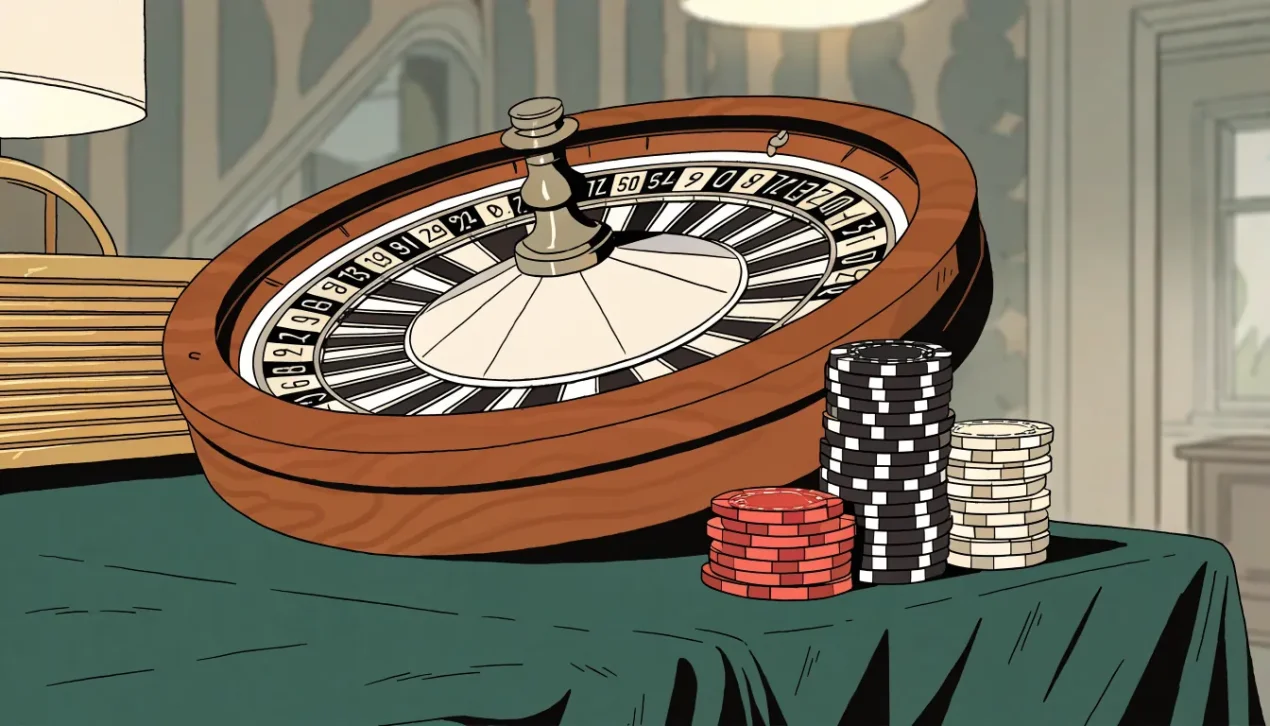
A guide to the single-zero wheel, common bets and payouts, and the differences between RNG, live and American roulette.
What Makes a European Roulette Table European
The defining feature is not a flag, a studio set or a name chosen for a game menu. It is the wheel’s single zero. That pocket shapes the arithmetic behind every wager and gives European roulette a recognisable standard against which online tables can be compared. A casino may present the game with different graphics or a live dealer, but the label alone says little unless the underlying rules are clear.
For a player comparing European roulette casinos in the UK, the house edge is a more useful starting point than the table’s decoration. In the standard version, that edge is 2.70%. It describes the mathematical advantage built into the game over time, not a forecast for an individual session. A short run can produce any pattern chance allows; the edge becomes meaningful across repeated play, where the rules rather than a lucky evening set the long-term balance.
The same figure can be expressed from the other side of the table. A theoretical return to player of 97.30% corresponds to a 2.70% house edge. That is a statistical measure, not a promise that a particular account, session or stake will return that share. The difference matters. Casinos often place percentages beside a game as if the number were a personal estimate; in roulette, it is a property of the rules, not a prediction about the next spin.

This makes the figure a practical point of comparison among online casinos with European roulette. It does not rank operators, and it cannot settle questions about interface, customer service or the conditions attached to bonus funds. It does establish what the standard game costs mathematically in the long run. If a table is advertised as European roulette but its rules depart from the standard version, the label is not enough to assess its odds. The published game rules need to be read alongside the name.
There is a small cultural history in the arrangement. Roulette turns chance into a public procedure: a ball, a wheel and a set of agreed rules make uncertainty legible. The house edge is the quiet institutional part of that ceremony. It does not require the casino to know what will happen next; it is built into the terms under which everyone waits to find out. Elegance, then, is not an absence of calculation. It is calculation made to look like play.
The phrase “best European roulette casinos” can suggest that one table will somehow improve the odds. That conclusion does not follow from the game’s appearance or from the presence of an online VIP room. Status and presentation may change the surroundings, but they do not by themselves change the standard European house edge. A useful comparison begins with the rules and the stated return, then distinguishes those from the operator’s other terms. “VIP” is a label, not a mathematical property.
That distinction also keeps roulette separate from the loose use of “slots” in casino menus and searches. A roulette table is not a slot game simply because both appear under the same casino heading. The former is organised around a wheel and its rules; its edge is calculated from those rules. A menu category does not turn one kind of game into another.
The mechanics are one matter; the legal setting is another. In Great Britain, real-money online casinos serving local customers must hold the relevant operating licence from the UK Gambling Commission. Online gambling is legal for adults aged 18 and over when offered by a UKGC-licensed operator, and operators must verify age before allowing a customer to deposit. Those requirements do not alter roulette’s probability. They govern who may offer the game and under what regulatory framework.
A comparison of European roulette tables therefore has two separate questions: what rules determine the game’s odds, and whether the operator is authorised to provide it to British customers. The single zero answers the first question’s defining point; the published edge puts its cost into a usable form. Neither guarantees a win. Chance remains stubbornly unimpressed by presentation.
Top online casinos in the UK
- SpinFormulaBonus: 550% Up To £15,000 + 550 FS · Payout speed: 1-3 business days
- SlotoSportBonus: 500% up to £ 10 200+ 777 FS · Payout speed: 1-3 business days
- Revery PlayBonus: 100% up to€1,000+ 100 FS · Payout speed: 1-3 business days
- AmunbetBonus: Join now and get 450% up to 2,700 GBP + 450 FS · Payout speed: 1-3 business days
- BeOnBetBonus: 100% up to €500 + 100 FS · Payout speed: 1-3 business days
- JetsetspinsBonus: 200% Bonus + 100 Free Spins + Free Royal Wheel · Payout speed: 1-3 business days
- NightWinBonus: £900 + 400 free spins · Payout speed: 1-3 business days
- x3betBonus: Welcome Pack 100% Up to £1.000 + 200 Free Spins · Payout speed: 1-3 business days
- ZombillionBonus: Welcome Pack 250% up to £4000 + 200 FS · Payout speed: 1-3 business days
- BritsinoBonus: Welcome Package – Get your £2,200 + 2,000 FS · Payout speed: 1-3 business days
The Single Zero and the Shape of the Wheel
A European roulette wheel is defined by a small asymmetry. Its numbered pockets run from 1 to 36, and alongside them sits a single zero. That makes 37 pockets in all: thirty-six numbered places and one green-marked exception. The arrangement is simple to describe, but it gives the wheel its particular identity. European roulette is not merely a familiar-looking circle with numbers around its rim; it is a closed set of possible landing places, with the zero included in that set.
The distinction between a number and a pocket matters. A number is the sign printed on a space; a pocket is the physical destination in which the ball can settle. On a real wheel, the numbered compartments divide the circular track into separate outcomes. In an online casino, the same structure may appear as a rendered wheel or as part of a game interface, but the underlying count remains the same. The image can change. The set of outcomes does not.
Thirty-six numbered pockets make the wheel look orderly at a glance. The single zero interrupts that impression. It is not another number in the run from 1 to 36, yet it occupies a pocket of its own and belongs to the same wheel. This makes the zero more than a decorative green patch. It is a distinct outcome, placed beside the numbered field but not absorbed into it.
That division is one reason the wheel is such a durable piece of casino design. Its structure can be understood before anyone learns the names of particular wagers or studies the printed layout on the table. There is a circle, a collection of compartments, and a ball that comes to rest in one of them. Each spin resolves into one pocket. The apparent motion is elaborate; the final answer is not.
A wheel also turns uncertainty into something visible. While the ball moves, every pocket remains present as a possible destination. Once it settles, the rest of the circle becomes irrelevant to that result. The numbered compartments give chance a physical address. In online play, a digital version keeps the same visual grammar: a circular track, discrete pockets and a single result at the end of the spin. The animation may make the process feel immediate or theatrical, but it does not alter the wheel’s basic composition.

For someone looking up how many pockets are on a European roulette wheel, the answer is therefore exact: 37. Asked how many numbered pockets it has, the answer is 36, with the zero forming the additional pocket. Those two ways of counting describe different parts of the same structure. Confusing them can make the zero seem like a margin or an afterthought. It is neither. It has its own place in the wheel’s set of outcomes.
The word “European” can sound like a label for presentation, as though it referred to the style of a table or the appearance of a game on screen. Here it names a particular wheel structure. The single zero is the identifying detail. A digital casino may place that structure inside a polished interface, while a live game shows the wheel itself, but neither format changes what is being counted. The distinction belongs to the game’s design, not to the room or device in which it is played.
There is a social neatness to the wheel. Casino games often turn complicated rules into objects that can be recognised at a glance: cards, dice, numbered spaces. Roulette makes this especially plain. Its circular form contains a finite collection of outcomes, while the movement of the ball briefly disguises how limited that collection is. The zero occupies a small part of the visible design, but its separate status is built into the structure from the start. A pocket is a pocket, whether the ball finds a numbered one or the green one.
European Roulette
Features a single zero and a house edge of 2.70%.
American Roulette
Features a double zero and a house edge of 5.26%.
That is the single-zero wheel in its most basic form: 36 numbered pockets, one zero pocket, 37 possible stopping places. There is no mystery in the count. The wheel’s theatre lies elsewhere.
Bonuses Meet the Roulette Table
A roulette spin can serve two purposes in an online casino: it can be play in its own right, and it can contribute to the wagering attached to bonus funds. Those purposes do not necessarily advance at the same rate. A bonus may come with a requirement to wager before its associated funds or winnings can be withdrawn, while the casino assigns different game weighting to different kinds of play.
For roulette, the proportion counted can be modest. Market summaries put the contribution at 10% to 20% for most UK operators, but this is a broad picture, not a universal term. The operator’s promotion rules determine whether a particular table counts, and how much of each stake is credited towards the requirement. A game’s name alone does not settle the matter: European roulette may appear in several formats, and the bonus terms can distinguish between them.
The distinction often made is between roulette run by a random number generator and live roulette streamed from a studio. A specialist review reports that RNG roulette can count at 100%, while live roulette may receive a 10% or 20% weighting. Those figures describe reported terms, not a promise that every offer follows the same pattern. Some promotions exclude live play altogether; other terms can assign it a smaller share than RNG play. The wording of the offer matters more than the reassuring presence of a roulette table in the casino lobby.
This difference reflects the way bonus rules classify games, rather than a change in the rules of European roulette itself. The wheel and the bonus ledger keep separate accounts. With a lower game weighting, only a fraction of the stake is counted towards the wagering requirement, so progress can be slower than the headline stake suggests. A player considering the best online casino for European roulette may therefore find that “best” depends partly on what is being measured: table choice, game weighting, or the conditions attached to bonus funds. There is no useful ranking without those terms.
The phrase “free European roulette” can also obscure two different things: access to play without staking real money, and a bonus that comes with conditions. A free-play option does not automatically satisfy a wagering requirement, while bonus funds are governed by the offer’s rules. The distinction is practical, not ceremonial. Treating every promotional balance as cash ready for withdrawal is a reliable way to misunderstand the arrangement.
A specialist review reports that, since January 2026, UK regulations cap bonus wagering requirements at a maximum of 10x for licensed operators. The cap limits the scale of the requirement; it does not make all offers alike or erase game weighting. A roulette stake can still count only in part, depending on the operator’s terms. A lower maximum is not the same as a simple one.
Bonus Wagering
Bonus funds often come with wagering requirements. In the UK, since January 2026, regulations cap these requirements at a maximum of 10x for licensed operators. Note that different games, such as live roulette versus RNG roulette, may have different weightings towards these requirements.
For British players, those terms sit within a regulated market. The UK Gambling Commission regulates online casino activity in Great Britain, and real-money casinos serving the market must hold the relevant licence. That does not make every promotion generous or every rule easy to spot. It does mean that bonus conditions belong to the operator’s regulated offer, rather than to an informal promise attached to a European roulette slot or table.
The careful reading is unglamorous: whether roulette is eligible, whether live and RNG play are treated differently, what game weighting applies, and what wagering remains before withdrawal. European roulette rules describe the game; bonus rules describe the bargain around it. A small distinction, with consequences.
Placing a Bet, Reading the Payout
An online roulette round follows a small, visible sequence: choose a stake, place it on the table, wait for betting to close, then see where the ball lands. The screen replaces the reach across a physical felt, but not the central arrangement: a wager marks an outcome, and the payout depends on how narrowly that outcome was selected. There is no need to learn every wager before a first spin. A number bet and an outside bet are enough to show the basic difference.
A straight-up bet selects one number. If that number wins, the stated payout is 35:1 in both European and American roulette. In other words, the odds describe the winnings relative to the stake; the returned stake is also included in the total credited after a winning round. The distinction matters when reading a table’s pay information: “35:1” is not the same as saying the entire return is thirty-five times the original stake.

Outside bets cover broader categories rather than a single number. Red or black, even or odd, and high or low all pay 1:1. A winning wager therefore returns winnings equal to the stake, with the stake itself returned as part of the total. Their apparent simplicity is part of their appeal: the choice is easy to read, though it does not make a result predictable. Each spin remains a matter of chance.
The practical steps are much the same whether the game is presented as a digital table or a live dealer stream. The player selects a chip value, places chips on the chosen area, and confirms or adjusts the bets before the round begins. Once betting closes, the game resolves the spin and displays the result and any payout. Interface details vary, so the table’s rules and pay information are worth reading before play; a familiar-looking layout does not make every variant identical.
A free-play mode, where an operator offers one, can show how the controls work without staking real money. It is useful for understanding where chips go and when bets can be changed, but it cannot turn roulette into a forecast. Real-money play adds the ordinary financial consequence: losing stakes come from the account balance, and a win is not evidence that a particular choice will work again.
In Britain, online gambling is legal at sites holding the relevant UK Gambling Commission licence. Operators must verify a customer’s age before allowing a deposit, and gambling is for adults aged 18 and over. New customers must be prompted to set a financial limit before their first deposit, with account-level controls available afterwards. UKGC-licensed casinos cannot accept credit cards for gambling. These measures sit around the game; they do not alter its payout table.
For anyone considering European roulette for real money, the useful distinction is between the amount staked and the amount returned after a win. A displayed payout ratio describes the winning wager, not a promise of regular returns. The arithmetic is plain. The outcome is not.
Do
- Check the operator’s UKGC licence
- Read the specific bonus terms and game weightings
- Set financial limits before your first deposit
Don’t
- Assume all roulette tables have the same house edge
- Treat bonus balances as cash ready for immediate withdrawal
- Confuse a roulette game with a slot game
Inside Bets: Neighbours on the Felt
Inside bets take their name from their position on the numbered part of the roulette table. Rather than covering a broad category such as red or black, they select numbers in close physical relation on the grid. The felt turns arithmetic into geography: a narrow boundary can carry a wager, and a short row can stand for three possible results.
A split bet sits across the line separating two adjacent numbers. The selection may run horizontally or vertically, depending on where the chosen pair appears. One chip placed on that boundary covers both numbers. If either comes up, the split pays 17:1. The compactness is part of its appeal: two neighbouring outcomes, one decision, and a payout that reflects a narrower chance of success than a bet covering a larger group.
“Adjacent” here means adjacent on the betting layout, not neighbouring pockets around the wheel. The distinction matters. A numbered grid is arranged in rows, while the wheel places its pockets around a circular rim. A pair sharing an edge on the felt is therefore a split-bet pair; the same two numbers need not sit next to one another on the wheel. The table gives the wager its shape.
A street bet covers a horizontal row of three numbers. The chip is placed at the row’s outer edge, marking that trio as a single selection. A winning street pays 11:1. It includes one more number than a split, so its payout is lower; the relationship is plain enough to read from the layout without turning the table into a lesson in probability.
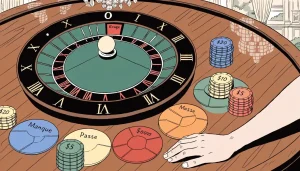
These wagers belong to the inside of the table because their territory is measured in individual numbers and small clusters. They make the grid feel less like a display and more like a map: boundaries matter, rows matter, and the chip’s exact position determines what it covers. A slip of placement can change the selection, so the lines are functional rather than decorative.
On a European roulette single-zero table, the same basic logic applies to the numbered grid: a split spans two adjacent numbers, while a street marks a row of three. The single zero is part of the wheel’s structure, not another member of a numbered street. The wager is defined by its position on the felt, not by a resemblance between numbers or by their order around the wheel.
There is a small social history in this way of laying out chance. The table makes complicated outcomes legible through simple marks: a boundary, a row, a chip. The player need not name a theory of probability to choose a pair or trio; the geometry does the explaining. The house, meanwhile, makes each choice precise enough to settle without argument. Chance gets a diagram.
The Wheel, the Pace and the Format
Roulette is often treated as a game with one fixed rhythm: the ball turns, bets close, a result appears, and the next round begins. Online, that rhythm depends partly on the format. Speed roulette is designed to move through rounds more quickly than a standard table, changing not the basic character of the game but the amount of pause between decisions.
A specialist review puts speed roulette at more than 150 spins per hour, compared with 80–100 at a standard table. Those figures describe a reported pace, not a promise that every session will keep the same tempo. Still, the difference is substantial: a faster sequence leaves less time between one result and the next, while a standard table gives the rounds more room to breathe.
That distinction matters because pace shapes the experience even when the game remains recognisable. A rapid succession of rounds can make an online casino with European roulette feel brisk and continuous. At a standard table, the intervals can make each round feel more separate. Neither tempo alters the underlying chance of a spin; speed changes how quickly the game presents those chances, not what they mean.
The attraction of speed roulette is easy to understand. It suits the impatience built into much digital entertainment, where waiting is often treated as a defect to be engineered away. Yet the interval between rounds has a function. It creates a moment in which one result ends and another begins. Remove much of that pause and the session can feel less like a series of distinct events, more like a stream.
That is a difference in atmosphere, not a strategy. No faster format makes outcomes more predictable, and a quicker succession of spins does not turn chance into a pattern. The speed can, however, make it easier for a session to gather momentum. The clock may pass unnoticed while the rounds accumulate.

For anyone comparing a casino with European roulette, the format label can therefore say something useful about the experience: whether the table is built around a measured pace or a compressed one. The figures reported for speed roulette should be read as a guide to the contrast rather than a guarantee about a particular table’s performance. The precise tempo can depend on how the game is run.
The old appeal of roulette lies partly in ceremony: a pause, a call, the ball’s last movement. Online formats can preserve that feeling or hurry it along. Speed has its own theatre. Less waiting, less space.
A Table Layout Built Around the Numbers
A European roulette table turns the wheel’s pockets into a surface that can be read at a glance. The numbered area is arranged as a grid, while the zero sits apart from the rows of numbered choices. It is a diagram rather than a miniature wheel: the layout makes selections visible and gives each wager a place on the felt or screen.
That distinction matters because the wheel and the table do different jobs. The wheel carries the pockets in a circular sequence; the betting surface reorganises them into a practical pattern. Numbers that sit beside one another on the grid are not necessarily neighbours on the wheel. The table is designed for placing bets, not for reproducing the wheel’s physical order.
On an online European roulette casino table, the same arrangement appears in digital form. A cursor or touch selects a position on the grid, and the interface shows where the stake has been placed. In a physical casino, chips occupy those spaces; online, markers or highlighted areas take their place. The felt has become a screen, but the underlying task remains legible: identify a number or a group of numbers, then mark the corresponding area.
- RNG Roulette
-
Roulette played via software that uses a random number generator to simulate spins, rather than a filmed physical wheel and dealer.
The layout also gives outside selections their own zones around the numbered grid. These broader areas sit apart from the individual-number spaces, so the surface distinguishes a narrow selection from a wider one without requiring a separate explanation each time. The table is, in this sense, a small piece of visual administration. It sorts choices before the wheel resolves them.
A European roulette table layout can therefore feel familiar even when its appearance varies between games. Colours, lettering, chip controls and screen proportions may change, but the central relationship stays steady: the grid represents the numbered pockets, and the zero has its own place. That consistency helps players move between a casino-style display and a mobile interface without having to learn a new map.
It does not make the map predictive. A European roulette strategy cannot be read from the spacing of the numbers on the felt, because the grid is an interface, not a forecast. Its order helps the hand find a position; it says nothing about where the ball will land.
Useful, not prophetic.
RNG Roulette and the Demo Question
RNG roulette replaces a filmed wheel and dealer with software that generates each result. The display may still show a familiar table, but the spin is simulated rather than captured from a physical wheel. That distinction is easy to miss when both formats use similar graphics. A polished, three-dimensional animation changes the presentation, not the underlying format.
The software generates outcomes through a random number generator. Spins can follow one another more quickly than in a live presentation, and some RNG tables have minimum stakes as low as 10p. That lower entry point is a feature of some games, not a promise that every table offers it. The pace can also make it easier for money to move quickly: faster play is a difference in tempo, not evidence that results are more predictable.

The word “demo” raises a separate question. A European roulette demo generally means a version presented for practice rather than real-money play, but the label alone does not establish what a particular game offers or whether its conditions match those of a real-money table. A practice screen can show how the interface behaves; it does not turn chance into a pattern that can be learned or forecast.
Searches for a European roulette slot, including versions described as gold, platinum or three-dimensional, may blur two categories. A roulette game presents roulette play; a slot is a different casino game, even when its title or graphics borrow roulette language. A name or visual theme is not enough to establish that a product follows European roulette rules. The game description and displayed format matter more than decorative wording.
For the same reason, a slot-demo label should not be treated as proof that a roulette table is available in practice mode. Product names and demo access can vary between operators. The useful distinction is simpler: RNG identifies a computer-generated roulette format, while demo describes a play mode. One is about how results are produced; the other is about whether play is for practice or real money.
Those categories are often presented side by side, as though animation, format and money status were one choice. They are not. A simulated spin can be shown in a plain interface or dressed up with elaborate graphics; a demo can be offered for one title and not another. The screen may look like a casino. The machinery is software.
Live Roulette: The Wheel on Camera
A live European roulette table puts a physical wheel in a studio and sends its image to an online casino. A human dealer sets the ball in motion; the camera follows the drop, while the digital table lets players place wagers remotely. The appeal is partly mechanical and partly theatrical: the wheel is present, the dealer’s actions are visible, and the result arrives through an actual ball rather than a simulated spin.

A specialist review reports that UK live roulette tables can start at 10p. That is a possible entry point, not a promise about every table: minimums vary, and the amount shown in a game’s rules is the relevant one. The same review distinguishes live tables from auto-roulette and speed formats, which can start at 5p. Those are separate formats, not evidence that every camera-streamed table offers the same minimum.
The camera does not alter the legal conditions. Real-money live roulette offered to people in Great Britain must come from a UKGC-licensed operator; a platform without a valid UKGC licence cannot legally offer it to British residents. The Gambling Commission is the sole regulator of online casino activity in Great Britain. A licence is a regulatory condition, not decoration around the broadcast.
Age checks come before deposits: operators must verify a customer’s age before allowing funds into a gambling account. UKGC-licensed operators must also offer deposit and loss limits, session reminders, reality checks, cool-off periods and GamStop self-exclusion. New customers must be prompted to set a financial limit before their first deposit, with account-level controls available afterwards. Limits, complaints procedures and other safeguards sit behind the camera, where they belong.
Before depositing, the operator’s licence number can be checked on the Gambling Commission’s public register. Game information, including RTP information where applicable, should be accessible; roulette’s live presentation does not replace the need for clear rules. UKGC licensees must provide an internal complaints process and access to an approved Alternative Dispute Resolution service. They cannot accept credit cards for gambling, including credit-card funds routed through a money service business or through a wallet that permits such use.
A real wheel, under regulated conditions. That distinction matters.

European or American: One Pocket Changes the Arithmetic
The difference between European and American roulette is easy to overlook on a screen. The numbered pockets from 1 to 36 appear in both versions, and both have a green zero. The American wheel adds another green pocket, marked double zero. That is the entire visible change; the arithmetic takes it from there.
A European wheel has 37 pockets in total. An American wheel has 38. On the American layout, the extra pocket is not a second chance for any numbered selection. It is another outcome on which the house wins, so the player’s chance of covering a particular number or group of numbers is reduced while the stated payout remains tied to the bet.
The difference is reflected in the house edge: 2.70% for European roulette and 5.26% for American roulette. The latter figure is not a penalty attached to a particular casino or a more complicated set of rules. It follows from the additional losing pocket. A green square can look modest. Its arithmetic is less so.
This is the useful distinction in European roulette versus American roulette: the basic numbered field is familiar, but the extra zero changes the underlying odds. A table’s name alone may not settle which version is being offered, so the wheel or betting layout is the meaningful clue. One green pocket points to the European format; two indicate the American one.
For an online European roulette casino game, the single-zero layout therefore matters more than any suggestion that a wheel can be read or anticipated. Neither arrangement makes a result predictable. The house edge describes the mathematical advantage built into the game over time, not a promise about the result of an individual spin.
The American wheel’s extra zero is a small design choice with a clear consequence: a higher house edge. European roulette keeps that extra pocket out of play. A simple difference. A lasting one.
Related posts

UK Casino Welcome Bonuses: How Offers Work

VPN-Friendly Casinos in the UK: How Access Works
