
Casinos That Accept Visa in the UK: What to Check
 Available in GB
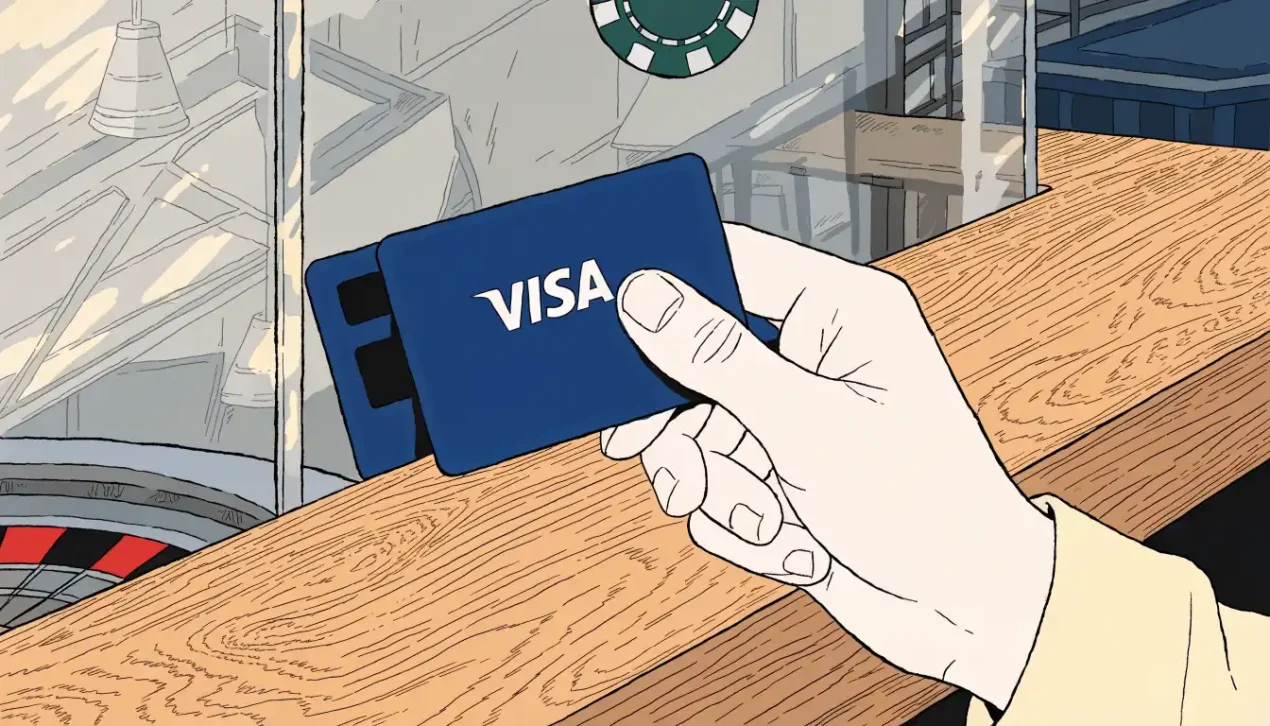
A Visa logo does not confirm a usable payment route: availability can vary by customer, and the cashier shows the current options.
Visa at the Casino Cashier: Availability Is Not a Guarantee
Visa remains a familiar payment name at UK casinos. Debit cards are commonly accepted, and Visa appears alongside Mastercard in descriptions of casino payment facilities. That broad picture explains why searches for casinos accepting Visa in the UK still make sense. It does not establish that a particular casino will accept a particular card when an account is opened.
The distinction is between a method being advertised and being available for a transaction. A specialist casino review may list Visa among a site’s payment methods, but that listing cannot confirm the current options shown to every UK customer. Payment arrangements can change, and the cashier is where the site presents the methods it currently makes available. A logo on a promotional page is a signpost, not a working payment route.
This matters because payment pages are often written to describe a service in general terms. The wording may cover more than one country, account type or card product. A casino’s name may be familiar, its site may mention Visa, and the cashier may still offer a different selection. The gap is not necessarily evidence of an error; it is a reminder that the cashier is the operational part of the promise.
For anyone comparing Visa casinos in the UK, the useful check is therefore specific: is Visa shown as an available method in the cashier for that account? A general page can help identify what to investigate, but it cannot settle the question. The answer is not contained in the payment logo alone.
There is a small but telling difference between “Visa accepted” and “Visa is available here, now”. The first can describe a casino’s general provision; the second concerns the actual options presented at the point of payment. In a market where payment details are liable to change, that distinction is more than editorial housekeeping. It separates a broad claim from a usable one.

The cashier also avoids a common confusion in lists of casinos that accept Visa. A list can collect sites whose information mentions the card, but that does not make every entry a confirmed match for every customer. A current check has to happen on the casino’s own payment screen, where available methods are displayed for the account in question. If Visa is absent there, an older description elsewhere does not make it present.
That can feel like a disappointingly plain answer to a request for the best Visa casino site in the UK. Yet “best” cannot be inferred from the card logo, and the basic question comes first: does the cashier offer Visa at all? Once that is established, other comparisons belong to separate questions. The payment label alone says nothing reliable about the wider quality of a casino.
Nor does the word “Visa” on a site settle the product question. The cashier needs to be checked for the card’s eligibility as well as for the payment method’s presence. Those are related checks, but not identical ones. A general site listing can name a card network without confirming that every card carrying that mark will work. The practical point is modest: the cashier’s current display is more useful than a logo or a broad description.
For the same reason, a page about new Visa casinos cannot promise that a newly encountered site will keep the method available. Newness does not make a payment route more certain. Availability belongs to the current cashier, not to the age of a brand or the confidence of its advertising.
The public language of casino payments tends to make access look effortless: a familiar logo, a short label, a reassuring tick. But payment systems are not static decorations. They are arrangements between the casino, the payment network and the customer’s account, and the cashier is where that arrangement becomes visible. A cautious reader of a casino’s claims is not being fussy; the interface simply contains more current information than a promotional page.
Visa casinos are still part of the UK casino landscape in the broad sense that debit cards, including Visa, are commonly accepted. Whether a particular site offers Visa to a particular UK account is a narrower, changing matter. That is why the cashier, rather than a list assembled elsewhere, has the final word on availability.
Logos are not guarantees.
Top online casinos in the UK
- SpinFormulaBonus: 550% Up To £15,000 + 550 FS · Payout speed: 1-3 business days
- SlotoSportBonus: 500% up to £ 10 200+ 777 FS · Payout speed: 1-3 business days
- Revery PlayBonus: 100% up to€1,000+ 100 FS · Payout speed: 1-3 business days
- AmunbetBonus: Join now and get 450% up to 2,700 GBP + 450 FS · Payout speed: 1-3 business days
- BeOnBetBonus: 100% up to €500 + 100 FS · Payout speed: 1-3 business days
- JetsetspinsBonus: 200% Bonus + 100 Free Spins + Free Royal Wheel · Payout speed: 1-3 business days
- NightWinBonus: £900 + 400 free spins · Payout speed: 1-3 business days
- x3betBonus: Welcome Pack 100% Up to £1.000 + 200 Free Spins · Payout speed: 1-3 business days
- ZombillionBonus: Welcome Pack 250% up to £4000 + 200 FS · Payout speed: 1-3 business days
- BritsinoBonus: Welcome Package – Get your £2,200 + 2,000 FS · Payout speed: 1-3 business days
When the Card Is Not the Only Route
A casino cashier can be less like a list of payment buttons than a small map of how money is expected to travel. Visa may sit beside bank transfer, an e-wallet or a prepaid voucher, but those options do not necessarily do the same job. One may fund an account and stop there; another may be available at both ends of the journey. The distinction matters more than the number of logos on the page.
Debit cards, including Visa and Mastercard, are commonly accepted by UK casinos, although the methods displayed can vary between operators. A cashier is the practical place to see what is offered for a particular account. Even then, a deposit button does not establish that the same method can receive a withdrawal. Payment menus describe routes with separate conditions, not a promise that every route runs both ways.
Open banking and bank transfers can be used for deposits and, at many sites, for withdrawals too. A specialist casino review describes these methods as capable of supporting instant deposits and fast withdrawals at many sites; that is a report about availability and performance, not a timetable for every account. The route can depend on the casino and the payment service involved. “Bank transfer” is a broad label, not one uniform experience.
E-wallets occupy a different place in the cashier. PayPal is often presented in specialist casino reviews as a popular choice for speed and convenience, but the account’s own cashier remains decisive about whether it is available and how it can be used. Skrill and Neteller are reported by specialist casino reviews at some sites. Their presence does not, by itself, settle whether either can be used for payouts. The cashier’s separate deposit and withdrawal options are the more useful evidence.

A prepaid voucher is more straightforward, though only in one direction. Paysafecard is deposit-only: it can put funds into a casino account, but it is not a route for receiving a withdrawal. That makes it a distinct kind of option from a bank account or a payment service that may support money moving both ways. A neat deposit is not the same thing as a complete payment route.
This is where the ordinary language of “payment methods” can conceal a practical difference. A cashier might group cards, online banking and vouchers under one heading, yet the account has to be considered as a sequence: money enters, play takes place, and any eligible balance later leaves by a route the operator can process. The familiar icon is only the entrance.
UK anti-money-laundering rules commonly require payouts to return to the original payment source. That principle helps explain why a method used for depositing can shape the route back, and why a deposit-only voucher cannot be treated as a withdrawal option. Where several methods have been used, the operator may have to apply its own payment procedures. The broad rule is about tracing funds, not about making every cashier identical.
The shape of the available route is also personal to the account. Payment methods can depend on the casino, the account details and the particular transaction. A method seen on a general information page might not appear in the cashier, while another may be offered for deposits but not for withdrawals. The useful distinction is therefore not simply card versus e-wallet, or old-fashioned bank transfer versus newer payment service. It is whether the chosen method can carry the transaction in the direction required.
Bank Transfer
Open banking and bank transfers can be used for deposits and, at many sites, for withdrawals too.
E-wallets
Methods like PayPal, Skrill, and Neteller are reported in specialist reviews, but the cashier remains decisive about availability.
Prepaid Vouchers
Options like Paysafecard are deposit-only and cannot be used as a route for receiving a withdrawal.
That is why a casino with several deposit choices may still offer a narrower way out. Some methods are bridges in both directions; others are one-way gates. A glance at the deposit screen answers only half the question. The withdrawal screen completes the map.
The habit of keeping the route legible has a quiet logic. UK gambling accounts are not merely containers for a balance; payments have to be associated with the customer and their source. When account information and payment details belong to the same person, basic ownership checks are less likely to create avoidable friction. It is not a guarantee of acceptance or speed, but it is a cleaner arrangement than trying to make unrelated accounts fit together.
So the alternatives alongside Visa are not interchangeable substitutes. Bank transfers and open banking may support both deposits and withdrawals at many sites, according to specialist reviews; Paysafecard is strictly for deposits; and e-wallet availability depends on the individual cashier and the route it permits. The payment menu is not decoration. It is the first sketch of how money may move through the account—and where it may have to return.
Debit Is the Relevant Word
A Visa logo identifies the payment network, not the kind of borrowing behind a card. For a gambling deposit in Britain, that distinction matters more than the familiar red-and-blue mark. A Visa debit card draws on money in a bank account; a Visa credit card borrows against a credit facility. UK-licensed casinos may accept the former, but cannot accept credit-card payments for gambling.

The ban took effect on 14 April 2020 and has not been relaxed. It applies to credit-card gambling at UK-licensed sites, including payments routed through a money service business. A credit card does not become an eligible gambling card simply because it passes through another payment layer. Nor does a Visa logo make a credit product equivalent to a debit card.
The rule reflects a judgement about who should bear the cost when gambling is funded with borrowed money. A debit payment uses funds already held in an account; credit makes the transaction part of a debt that may outlast the evening. The distinction is not a comment on the person holding either card. It is a boundary placed around the payment mechanism.
That leaves a practical answer to whether online casinos still accept Visa deposits in the UK: debit cards, including Visa, are commonly accepted, while credit cards are not permitted for gambling at UK-licensed casinos. “Visa accepted” is therefore incomplete wording. It may describe the network, but it does not establish that every card carrying the logo is eligible.
A card can also be mistaken for a different product because it is contactless, stored in a digital wallet, or used for everyday purchases in the same way as another card. The relevant distinction remains the underlying card type. A digital presentation does not turn a credit card into a debit card, and a payment route cannot be used to sidestep the restriction.
This is why the payment label and the account behind it need to agree. A Visa debit card is not interchangeable with a Visa credit card for casino deposits, even if both are issued by the same bank and look alike at the checkout. The cashier’s wording should identify the accepted method clearly; where the card’s status is uncertain, the bank’s product details are more useful than the logo alone.
There is a further difference between eligibility and availability. A debit card may be the permitted kind of card yet still not be offered by a particular casino’s cashier, or may not work for a particular account. Conversely, a site listing Visa does not mean that credit-card funding is allowed. The card product and the operator’s available payment route are separate questions.
Promotional language does not change that boundary either. A reference to spins, a bonus or a deposit offer cannot make a prohibited credit-card payment acceptable. Nor does the presence of a Visa mark on a promotion establish which card products qualify. Payment eligibility and offer terms are distinct matters, and the word “Visa” alone settles neither.
The useful shorthand is plain: Visa debit may be accepted; Visa credit cannot fund gambling at a UK-licensed casino. Both cards carry the same network name. Only one is an eligible card type for that purpose. A small word, with a large job.
A Mobile Slot Still Depends on the Cashier
A slot fitting a phone screen says nothing about the route by which money can enter a casino account. The game and the cashier are separate parts of the service: one presents the play, the other determines which payment methods are currently available to that account. A Visa logo on a general payments page, or a site appearing in a specialist review that lists Visa and Mastercard, is a useful lead, not confirmation that Visa will work on a particular mobile visit.

The cashier is the point where the distinction becomes practical. Its payment options may depend on the casino’s current arrangements and on whether the particular card product is eligible. Those details need checking there, rather than inferred from the fact that the casino offers online slots or that its pages adapt neatly to a small screen. Mobile design can make the route look seamless. It cannot make two separate systems identical.
This matters for searches for Visa slots in the UK, which can make the card sound like a feature of the game itself. It is not. A slot does not accept a card; the casino account does, through the payment methods shown in its cashier. Whether a mobile browser or casino app is being used, the relevant evidence is the current payment screen and its stated conditions.
Nor does a polished mobile experience establish that a casino is legitimate. In the UK, remote gambling licensees serving customers in Great Britain must hold the relevant Gambling Commission licence. That status concerns the operator, not whether a Visa mark appears beside a slot or in a promotional panel. A payment logo is not a licence badge.
The less visible detail is often the one that decides the transaction: the card must be supported in that cashier, and its product type must be eligible. A listing that names Visa cannot settle either point for every customer or every moment. Payment arrangements change; a page describing them may lag behind the account’s actual options.
That makes the phone a viewing device, not a guarantee of payment compatibility. A casino can offer mobile slots while its cashier presents a different set of methods than an overview page suggests. Checking the cashier before relying on Visa keeps the distinction clear: the game runs on the screen; the payment decision belongs to the account.
Real-Money Play, and the Longer Journey Back
A Visa deposit and a withdrawal are separate stages of a real-money transaction. A card payment may be confirmed quickly, putting funds into a casino balance for play. That speed says little about how long it will take to receive winnings later. The cashier is not a revolving door; money does not simply retrace its steps at the same pace.
A specialist casino review describes the contrast plainly: a card deposit can be instant, while a payout may take several business days. That is an account of the timing reported for a particular service, not a promise that every Visa transaction will follow the same schedule. The practical point is the difference between payment authorisation and payment delivery. An immediate deposit confirmation marks the start of play, not a clock guaranteeing an equally immediate return.
Real-money slots played with Visa depend on the casino’s payment arrangements, but the game itself does not determine the withdrawal timetable. Once a withdrawal is requested, the operator has its own processing stage. Withdrawal processing times include that internal approval; for a first withdrawal, verification may add further time while the account is checked. A specialist review notes that these first cash-outs can take longer when verification is still being completed. The balance on screen and money received are not the same thing.
That distinction can be easy to miss when the deposit side feels effortless. A casino account may show a successful card payment before the later administrative work has begun. A withdrawal request, by contrast, is not necessarily sent onward for payment the moment it is submitted. Internal review and account checks sit between the request and its completion. No drama is required for a delay; sometimes the process is simply still in progress.

The first withdrawal deserves particular attention because it may be the point at which outstanding verification is completed. KYC can therefore matter to the journey back as much as the original deposit mattered to getting started. If verification is unfinished, a fast card payment does not remove that task. The timing depends on the casino’s approval process and the state of the account, rather than on the speed of the earlier deposit alone.
This is why claims about Visa slots or real-money play should not be read as claims about payout speed. A casino can accept a card deposit promptly and still take longer to process a withdrawal. A review can offer a useful indication of a site’s stated arrangements, but the cashier and the operator’s withdrawal information are the relevant places to confirm the current process. The deposit button is only half the story.
For anyone comparing casinos that accept Visa, the useful comparison is not merely whether a card can fund play. It is also whether the withdrawal process is clearly explained and what verification may be required before the first payout. The time between a winning balance and money arriving in an account is part of the real-money experience, not a footnote to it.
Different clocks. Different work.
The Original Source Often Gets the Return
A Visa deposit and a Visa withdrawal are not necessarily two movements along an equally open road. Under UK anti-money laundering rules, a casino will generally seek to return funds to the payment source used to put them into the account. This closed-loop approach helps establish where money came from and where it is going; it is also a fraud control, not simply a preference in the cashier’s design.
That distinction matters when a casino advertises Visa for deposits. It does not, by itself, promise that every later payout can be sent directly back to the same card. The operator’s cashier and withdrawal instructions determine which routes are available for that account and transaction. A Visa debit deposit may therefore be part of the return process, but card acceptance at the deposit stage is not proof of a direct Visa withdrawal facility.
Changing the route can create more work. If the original source cannot receive a payout, or another method is proposed, the casino may ask for additional verification before releasing funds. The purpose is to check ownership and the destination of the money. Keeping account details and the payment route under the same customer’s name can reduce avoidable questions about who controls the funds. Less ambiguity, fewer loose ends.
Withdrawal timing is separate from routing. A specialist casino review notes that speed can depend on the operator’s internal approval process and whether the account has been fully verified. That means a payment method described as fast does not settle how quickly a particular withdrawal will be completed: checks inside the casino remain part of the journey.
For anyone comparing Visa debit fast-withdrawal casinos in the UK, the useful distinction is between a card accepted for deposits and a card explicitly available for payouts. “Visa direct withdrawal” should be treated as a specific cashier feature to confirm, not inferred from a Visa logo or a successful deposit. A casino may need to complete checks, or may direct funds back through the original source before another route is considered.
The same logic applies when the deposit was made to play slots. The game does not alter the return route; the account’s payment record and the operator’s controls do. Visa is not closed as a UK payment method simply because a particular casino’s cashier does not offer a particular payout path. One is a card network; the other is an operator’s transaction policy. Not the same thing.
Bonuses Have Their Own Payment Fine Print
A Visa symbol in a casino cashier answers one question: whether that card can be used for a transaction there. It does not answer whether a particular welcome offer, slots promotion or bonus code is available when Visa is chosen. Those are separate decisions, made in the promotion’s terms.
The distinction matters because a bonus is not simply attached to an account as soon as a deposit arrives. Its conditions may name eligible payment methods, require an offer to be selected or entered, or exclude a method altogether. The cashier and the promotion page therefore need to tell the same story. If they do not, the offer’s wording governs its own eligibility; the presence of Visa in the payment menu cannot settle it.
E-wallets show why that separation exists. A specialist casino review reports that PayPal can be excluded from bonus eligibility, despite its appeal as a payment option. The same kind of review reports that Skrill and Neteller are often excluded from promotions at sites that accept them. These are not universal rules for every casino or offer. They are reasons to inspect the terms attached to the specific promotion rather than infer eligibility from a familiar logo.
Bonus Eligibility
Bonus conditions may name eligible payment methods or exclude certain ones, such as e-wallets like PayPal, Skrill, or Neteller.
If a method is not named in the promotion terms, its eligibility is not guaranteed, regardless of whether it is accepted in the cashier.
The operator’s language may distinguish between depositing with a method and claiming an offer after depositing. It may also set out whether a bonus code is required or whether the offer must be activated first. A deposit can be successfully credited while the promotion remains unavailable: payment processing and promotional qualification are separate administrative tracks. The paperwork has its own little kingdom.
For Visa casino bonuses, the practical check is therefore not just whether Visa appears in the cashier. The promotion terms should identify the qualifying payment methods and any steps needed to activate the offer. If Visa is not named, silence should not be treated as approval. Likewise, a payment method excluded from one promotion may still be usable for another transaction at that casino.
No-deposit offers raise a different question because their defining feature is that a deposit is not required to receive the offer. That does not establish that every such promotion is open to every account or has no conditions; its own rules still apply. A bonus code, a welcome offer and a payment method belong to related parts of the account, but none automatically guarantees the others.
Minimum Deposits and Limits at the Point of Payment
The minimum shown beside a deposit method is a small but consequential piece of casino policy. A specialist review reports entry points of £10–£20, with the amount depending on the payment method. That is a reported range, not a promise that every Visa cashier will accept either figure: the operator’s current deposit screen sets the threshold for the account and method in use.

Maximums are less uniform. A casino may set a ceiling for one transaction and separate limits across a day or month; those figures can also depend on payment method and account status. Verification, account history and the operator’s own controls may therefore matter as much as the card itself. A headline limit on a general information page is less useful than the amount displayed after login, where the conditions apply.
The distinction matters for small deposits, too. A Visa payment described as instant concerns the processing of that transaction, not the amount the casino will accept. A £5 deposit may appear in a search for Visa casinos, but it should not be treated as an available minimum without confirmation in the cashier. Payment labels do not set deposit thresholds. Operators do.
There is a separate control before any first deposit. UKGC rules require remote gambling licensees to prompt new customers to set a financial limit before depositing, and to make account-level limit controls accessible. This is not merely a cashier setting: it belongs to the wider arrangement through which gambling is permitted and bounded. The first payment is thus also a point at which the account’s own limits must be made visible.
A deposit limit and a financial limit are not the same thing. The former restricts what a payment route or casino will process; the latter is an account control set within the operator’s required framework. Both can shape how much enters an account, but they answer different questions. One concerns the transaction. The other, the customer’s spending boundary.
For Visa deposits, the practical check is therefore the cashier’s stated minimum and maximum, alongside the account’s financial-limit controls. Amounts can vary; the obligation to provide those controls does not.
Do
- Check the cashier for the current minimum and maximum limits.
- Confirm if a method supports both deposits and withdrawals.
- Verify the specific terms of any bonus or promotion.
Don’t
- Rely on a Visa logo as a guarantee of specific card eligibility.
- Assume a deposit method is also available for payouts.
- Treat a general information page as a real-time payment guide.
If Visa Is Unavailable, Compare the Whole Route
A useful substitute for Visa is not simply the method that gets money into a casino account. It is the route that also suits a later withdrawal, has understandable costs and avoids unnecessary currency conversion. A deposit button tells only half the story.
Open banking and bank transfers can support deposits and withdrawals at many sites. A specialist review describes these methods as capable of providing instant deposits and fast withdrawals, but that is not a promise about every casino or transaction. Bank processing, the casino’s own procedure and the payment method shown in the cashier all matter. PayPal and debit cards connected to fast-payout systems are also identified in specialist reviews among the quicker withdrawal routes; availability still depends on the operator.
That makes a cashier check more useful than a general ranking of payment brands. It should establish whether the method is available for both directions, whether the casino imposes a charge, and whether the account can receive funds in pounds. A payment that converts currencies may carry an exchange-rate spread even when no obvious flat fee appears. The small print is not always small in effect.
Costs can arise at several points: the casino, the payment provider, the card issuer or bank, currency conversion, and, where relevant, a payment network. A specialist review notes these as possible charges, rather than a fixed tariff for every route. There is no universal cheapest option; the comparison has to reflect the amount being moved and the actual terms shown by the casino and provider. A visible fee is only one part of the price.
The same route can also matter after a deposit. UK anti-money-laundering controls commonly direct payouts back to the original payment source, so a method that accepts deposits but cannot receive withdrawals may leave an account needing another route and further checks. Consistent use of an account in the same customer’s name can reduce avoidable ownership questions.

Visa remains a payment method, but no substitute is automatically better merely because it is available. The sensible comparison is the full circuit: deposit access, withdrawal support, processing conditions, fees and currency. A cheaper-looking entrance may have a more complicated exit.
Visa and the Question of GamStop Status
Visa acceptance and GamStop status are separate questions. A Visa logo, or a Visa option in a cashier, says something about a payment route; it does not establish whether a casino is connected to GamStop. The same applies to claims that a site offers slots outside the scheme. Payment branding is not a reliable guide to a platform’s regulatory position.
For casinos serving customers in Great Britain, the more important distinction is whether the remote gambling licensee holds a current UK Gambling Commission operating licence. That requirement applies regardless of where the company is based. A casino’s own description of its status is not a substitute for checking the licence on the Commission’s public register. Northern Ireland has a different legal framework from Great Britain.

The phrase “not on GamStop” can cover very different circumstances. It may describe an inaccurate or outdated claim, or a site outside the UK regulatory system. An offshore casino may be accessible from the UK, but it does not thereby become a UK-licensed casino. Visa acceptance does not settle that distinction, nor does it show what self-exclusion protections apply.
UK-licensed remote operators must provide responsible-gambling tools, including self-exclusion. They must also prompt new customers to set a financial limit before their first deposit and make account-level limit controls accessible. These obligations concern the account and the operator; they cannot be inferred from a card logo or from a promise on a payment page.
So a list of “non-GamStop casinos that accept Visa” would suggest that two facts had been checked for each named site: its Visa availability and its relationship to the scheme. One does not prove the other, and a payment method cannot verify a casino’s regulatory status. That distinction matters most when a site presents UK payment options while its licensing position is unclear.
A card can open the cashier. It cannot certify the house.
Are Visa and Mastercard deposits definitely debit cards?
No. Visa and Mastercard are card networks, and a casino listing either does not confirm that every card carrying that logo is eligible; check the cashier for your specific card.
Why can a fast-payout casino still delay my withdrawal?
A payout can be held up by the casino’s approval process or account verification, especially on a first withdrawal. The payment method and its processing time can also affect how quickly funds arrive.
Can I deposit in GBP?
Yes, GBP is supported, but check your account currency before depositing to avoid conversion.
Are fast casino withdrawals guaranteed?
No. Withdrawal speed depends on the casino’s approval process, whether your account is verified and the payment method; a card deposit can be instant while a payout takes several business days.
Which payment methods are accepted in Great Britain?
UK casinos commonly accept Visa and Mastercard debit cards, and may offer bank transfers, open banking and e-wallets. Paysafecard is for deposits only, and the options available for your account are shown in the casino cashier.
Related posts

UK Casino Welcome Bonuses: How Offers Work

VPN-Friendly Casinos in the UK: How Access Works
