
EntroPay at UK Casinos: Check Availability at the Cashier
 Available in GB

A network logo alone does not confirm that a casino accepts an EntroPay product for UK accounts or supports it for payouts.
EntroPay Availability Needs Checking at the Cashier
A casino’s acceptance of EntroPay cannot be inferred from a payment-method list that mentions Visa or Mastercard. Those names describe card networks; they do not establish that a particular EntroPay product is eligible, or that the casino currently accepts it for a UK account. For anyone looking for casinos that accept EntroPay in the UK in 2026, the useful distinction is between a network logo and a payment option actually offered in the cashier.
A specialist casino review lists Visa and Mastercard among the methods connected with the sites it covers. That is a narrow statement about the listed card brands, not confirmation that EntroPay will work at any of those casinos. The cashier is where the operator’s current options are presented, and where an eligible card product can be distinguished from one that merely carries a familiar logo.
This distinction is easy to lose in online listings. A page may group card products under Visa or Mastercard, while a casino’s payment system makes decisions at a more specific level. A network logo alone does not show which products are accepted, whether a given product is available to a UK account, or whether the payment option remains enabled. It cannot settle those questions by itself.
An old listing is especially poor evidence of present acceptance. Payment arrangements can change, and a page that once described an available option may continue to appear after the cashier has changed. The date attached to a page may help explain its context, but it does not substitute for what the casino currently displays. Search visibility is not a cashier function.
The same caution applies to pages that use broad wording such as “Visa accepted”. Such wording may accurately describe the casino’s support for some Visa cards without covering every product connected to the network. Treating it as proof of EntroPay acceptance turns a general label into a promise it does not make. A neat logo is not a contract.

For the same reason, a list titled as a collection of EntroPay casinos should not be read as confirmation merely because it names familiar operators or card brands. The claim needs to be specific to the method and current to the account being used. If the cashier does not present EntroPay as an available choice, a general reference to Visa or Mastercard elsewhere on the site does not fill that gap.
This is not a small technical distinction. Payment systems identify instruments in ways that can be more exact than the branding printed on a card or shown in a review. The casino may accept one card product and reject another under the same network. A UK customer may also see a different set of options from someone using another account or location. The visible list at the point of payment is therefore more informative than a broad description copied from a directory.
The practical test is straightforward: look for EntroPay itself in the casino cashier, rather than assuming that Visa or Mastercard support includes it. If the method is not shown, the network logo is not a reliable substitute. If it is shown, the eligibility information presented there still matters; a displayed option does not mean every card product bearing a related brand will be accepted.

This also explains why lists of “top” or “best” EntroPay casinos can overstate what they establish. A ranking may arrange sites according to its own editorial criteria, but the order cannot prove that a payment route works now. Where the underlying claim rests only on a card-network logo or an old description, the ranking adds presentation, not evidence of current acceptance. The cashier remains the decisive point.
The wording on a casino’s payment page may be broad, while the operational choice in the cashier is precise. Those two parts of a site should not be treated as interchangeable. A general payment page can identify networks the operator supports; only the current cashier can show which methods are offered in the transaction being made. The difference is modest in appearance and decisive in practice.
So the question is not whether a casino accepts Visa or Mastercard in general, but whether EntroPay is currently available as an eligible method for that UK account. Without that specific confirmation, a listing should be read as a lead to check, not as proof. No logo can do the cashier’s job.
DO
- Look for EntroPay specifically in the casino cashier.
- Verify if the method is available for your specific UK account.
- Confirm the account currency is in GBP before depositing.
DON’T
- Assume EntroPay is available just because Visa or Mastercard logos are shown.
- Treat a general payment page as a guarantee of specific method availability.
- Rely on old reviews or directories to confirm current acceptance.
Top online casinos in the UK
- SpinFormulaBonus: 550% Up To £15,000 + 550 FS · Payout speed: 1-3 business days
- SlotoSportBonus: 500% up to £ 10 200+ 777 FS · Payout speed: 1-3 business days
- Revery PlayBonus: 100% up to€1,000+ 100 FS · Payout speed: 1-3 business days
- AmunbetBonus: Join now and get 450% up to 2,700 GBP + 450 FS · Payout speed: 1-3 business days
- BeOnBetBonus: 100% up to €500 + 100 FS · Payout speed: 1-3 business days
- JetsetspinsBonus: 200% Bonus + 100 Free Spins + Free Royal Wheel · Payout speed: 1-3 business days
- NightWinBonus: £900 + 400 free spins · Payout speed: 1-3 business days
- x3betBonus: Welcome Pack 100% Up to £1.000 + 200 Free Spins · Payout speed: 1-3 business days
- ZombillionBonus: Welcome Pack 250% up to £4000 + 200 FS · Payout speed: 1-3 business days
- BritsinoBonus: Welcome Package – Get your £2,200 + 2,000 FS · Payout speed: 1-3 business days
The Payment Methods UK Casinos Commonly Offer
The payment menu at a UK casino is less a universal list than a small portrait of the operator’s arrangements. Debit cards remain the familiar starting point: casinos commonly accept Visa and Mastercard debit cards. That does not mean every card product will work at every cashier, or that a logo on a general information page settles the matter. EntroPay should not be inferred from the presence of Visa or Mastercard. A payment brand and a particular prepaid or virtual card product are not interchangeable promises.
The distinction between debit and credit matters in Britain. Credit-card payments for gambling have been prohibited since 14 April 2020, and the restriction remains in force. A card-based option therefore needs to be understood as a debit route, not treated as permission to fund gambling with credit. The rule also reaches credit-card funding passed through a money service business. Payment menus may look like ordinary retail checkout pages; the permitted route is narrower.
PayPal occupies a different place in the landscape. It is valued for speed and convenience, but that description should not be mistaken for a guarantee that it will appear at every casino or suit every offer. A specialist casino review notes that PayPal may be excluded from bonus eligibility. The practical consequence is not that PayPal is inherently incompatible with promotions, but that the payment method and the offer can have separate conditions. A promotional banner does not necessarily describe every route through the cashier.

Open banking and bank transfers are another part of the modern menu. Specialist payment reviews describe these services as capable of providing instant deposits and fast withdrawals at many sites. That is an account of the options reported in those reviews, not a fixed timetable for every operator or transaction. The broader change is significant: payments can be authorised through a bank connection rather than entered as card details, while the underlying bank account remains central to the movement of money. The new interface does not abolish the old institution.
Prepaid vouchers offer a more bounded arrangement. Paysafecard is a voucher used for deposits only. That makes it unlike a bank account or an e-wallet that may participate in more than one stage of a casino transaction. Its purpose is clear, but its limits are equally clear: a deposit method should not be presumed to provide a route for receiving money back. A payment label can describe only one direction.
E-wallets such as Skrill and Neteller appear at some casino sites. Specialist casino reviews report that these wallets are often excluded from promotions, another reminder that bonus terms may distinguish between payment routes. Their availability is not universal, and their presence in one casino’s menu says little about another’s. Nor does the word “wallet” make separate services identical: each has its own account arrangements and the operator decides which routes it supports.
The range may also include more than one kind of bank-linked or digital payment. Some menus combine cards, bank transfer, e-wallets and other services; others present a shorter selection. That variety reflects commercial and technical choices as much as consumer preference. A casino’s cashier is not a public directory of every payment method in Britain. It is a list of the routes that a particular operator has made available to its customers.
Debit Cards
Commonly includes Visa and Mastercard, but requires verification at the cashier.
PayPal
Valued for speed and convenience, though it may be excluded from certain bonuses.
E-Wallets
Services like Skrill and Neteller are available at some sites but may have different bonus terms.
Vouchers
Methods like Paysafecard are often used for deposits only and not for withdrawals.
For someone looking for an online casino that accepts EntroPay in the UK, this wider landscape supplies context, not a substitute list. Visa and Mastercard debit cards, PayPal, bank services, vouchers, Skrill and Neteller each have different functions and conditions. None should be presented as an EntroPay replacement merely because it is another way to pay. The useful comparison is between what each route actually does, not the resemblance of its name or logo to a card-based service.
That distinction is easy to lose in a market where payment symbols are displayed as shorthand. A card logo may indicate a network, while eligibility depends on the card product and the casino’s current arrangements. An e-wallet may be available but treated differently for promotions. A voucher may fund an account without serving for payouts. These are not minor footnotes; they define what the method is for.
The UK payment landscape is therefore varied, but not interchangeable. Debit cards are common; other options appear with differing availability and restrictions. EntroPay remains a separate question, rather than a conclusion that can be drawn from the presence of familiar payment brands. A logo is only an invitation to check.
Checking a Casino’s Payment Terms Before Registration
A payment method mentioned in a casino review is not the same thing as a confirmed option for a particular account. The cashier and the operator’s own terms are the relevant places to establish what can actually be used. That distinction matters when looking for a UK casino that accepts EntroPay: a label on a third-party page may describe an earlier cashier, a different market or an option that is not available to every customer.
Before creating an account, the casino’s payment information should be read as a set of conditions, not as a decorative row of logos. The terms may distinguish between deposits and withdrawals, specify which currencies an account can hold, or explain that availability depends on the country selected during registration. A method’s name appearing somewhere on the site does not, by itself, settle those questions.

Where the cashier can be viewed without signing in, it offers a useful first check. If it cannot, the operator’s published payment terms or customer support can clarify whether EntroPay is currently listed for UK accounts. The answer should be specific to the site and the intended account, rather than a general statement that the method is accepted somewhere in its wider operation. Payment options can vary; a broad brand-level claim does not resolve the terms of one particular account.
The wording of the response matters too. “Available” may refer only to deposits, while the practical question concerns the complete route for the account. If the reply is unclear about whether the method appears in the UK cashier, or treats a historic listing as confirmation, it leaves the essential point unsettled. A careful check records what the operator says and where the option appears, rather than relying on a copied list without context.
Currency deserves its own check before any transaction. A specialist casino review reports that GBP is supported, but the currency assigned to an individual account should still be confirmed directly with the operator. That is not a contradiction: a site may describe pound support in general while the account setup or selected payment route presents a different currency. The first deposit is a poor moment to discover that the displayed balance is not denominated in pounds.

The account currency should be visible in the registration information, cashier or account settings, or confirmed by support before money is sent. The deposit screen is especially important because it shows the amount that will be credited and the currency in which it is expressed. If those details do not match, the transaction should wait until the operator explains the arrangement. A conversion can change what leaves the payment account and what arrives in the casino balance; the published presence of GBP elsewhere does not remove that possibility.
It is also worth keeping the terms for the intended method separate from general payment pages. Some operators publish broad descriptions that cover several countries, while an individual cashier may display only a narrower selection. Terms that refer to “selected methods” or regional availability need a direct answer for the account being opened. The aim is not to infer what the casino might permit, but to establish what its own current information says.

A simple pre-registration record can prevent confusion: the operator’s statement on EntroPay, the page or support reply where it appears, and the currency shown for the account. If these do not agree, the inconsistency is itself useful information. It is better to pause than to treat an old review as a promise that the cashier will reproduce.
There is no meaningful “best” EntroPay casino list without verified, site-specific terms. A shortlist assembled from unqualified mentions can look definite while saying little about present availability or account currency. In Britain, real-money gambling is legal only with a properly licensed operator; that status is separate from whether a particular payment method appears in its cashier. The two checks answer different questions.
Registration can wait until both are clear: whether the operator currently offers the stated method to the relevant UK account, and whether that account will transact in GBP. The small administrative pause is less consequential than sending funds under an assumption the site’s own terms do not support. No guesswork required.
What Happens Between Deposit and Payout
A deposit and a withdrawal may look like opposite movements through the same cashier, but they are not necessarily treated as mirror transactions. Money arriving at a casino is one part of the record; money leaving it is another, subject to checks on its destination and the account behind it. That distinction matters to anyone considering EntroPay online casinos in the UK: a method displayed for paying in does not, by itself, establish how a later payout would be handled.
UK anti-money laundering rules commonly require a casino to return funds to the payment source used for the original deposit. This closed-loop approach helps prevent gambling accounts from becoming a convenient route for moving money between unrelated people or accounts. It can also make a withdrawal less like a simple cash-out and more like the final stage of a documented transaction.
The cashier’s deposit screen therefore tells only part of the story. A payment option may be available when funds are added, while the casino’s payout process still follows its own rules about the return route. The practical question is not merely whether an EntroPay payment can be initiated, but whether the casino’s stated process can accommodate the path from deposit through to withdrawal. A logo cannot answer that.
For online casino sites that accept EntroPay in the UK, the same distinction applies whether the account is opened on a computer or through a mobile site. The device changes the view of the cashier, not the underlying transaction record. A casino may record the payment source, the amount and the account receiving it, then assess a withdrawal against that history and its applicable checks. The route is administrative as well as financial.
Verification sits between those two stages. A specialist casino review describes withdrawal processing as including the operator’s internal approval, with first withdrawals potentially taking longer while verification is completed. That is a description of a process, not a promise about a particular site or a fixed timetable. The operator’s review queue and the state of the account can both matter; an instruction to withdraw does not mean that funds have already left the casino.
This can make the first payout feel different from later ones. The casino may need to complete KYC before approving the request, and any outstanding checks can hold up the process. The delay does not necessarily mean that a payment has failed. It may mean that the casino has not yet completed its own review. The cashier’s status and the operator’s terms are more useful than assuming that the speed of a deposit predicts the speed of a withdrawal.
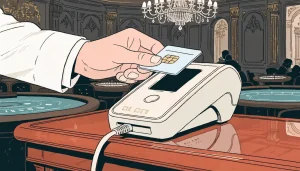
The arrangement is especially relevant to EntroPay payment casinos because acceptance at the point of deposit should not be confused with confirmed payout compatibility. A site’s payment page may be brief, while its withdrawal terms set out the return-to-source rule or explain how it handles cases where a source cannot receive funds. Those details define the transaction path. If the terms are unclear, the method should not be treated as a complete deposit-and-withdrawal option on the strength of its deposit symbol alone.
There is a small cultural history in this procedure. Digital money is often presented as frictionless, as though a transfer were merely a gesture across a screen. Gambling regulation insists on a less romantic view: funds have an origin, an account holder and a route that can be examined. The paperwork is the point. A payout is not simply the reverse of a deposit; it is a second decision, made after the first has been recorded and checked.
Real-Money Deposits and Their Minimums
A first real-money deposit is not necessarily a large one, but the minimum is set by the payment route and the casino rather than by a universal UK rule. A specialist casino review puts the starting range at £10–£20, with the method selected affecting where the minimum falls. That is a useful indication of scale, not a promise that every cashier will display the same threshold.
The distinction matters for anyone looking for an EntroPay casino in the UK. A payment method’s name in an old listing does not establish that it can be used now, or that a particular account will be eligible. Nor does a low minimum elsewhere tell anything reliable about an EntroPay option. The amount becomes relevant only after the cashier shows the method as available and states its current terms.
There is a small but important difference between the advertised minimum and the amount a person intends to spend. The first is the smallest deposit the cashier will accept through a selected route; it is not a recommendation, a measure of what is affordable, or a guide to how long gambling will last. Once funds reach an account, their presence can make further play feel like a continuation of the same decision. It is still another decision.
The range of £10–£20 should therefore be read as a broad starting point reported by a specialist review, not as a fixed standard across British casinos. One site may attach a different minimum to different payment methods, and the displayed figure can be more useful than a general description of what casinos tend to allow. A modest threshold does not make a payment method compatible, either: the cashier must confirm that it is available for that account.
Minimum deposits are also separate from maximum deposit caps. A minimum answers how little a particular transaction can be; a cap concerns how much may be deposited in one transaction or over a period. Those limits can vary with payment method and account status, so neither figure can stand in for the other. Small print, but consequential.
For someone comparing real-money casino deposits, the practical point is not to treat £10–£20 as a guaranteed EntroPay entry price. It is a reported range for minimum deposits, with the selected method shaping the result. The cashier’s stated minimum is the operative figure; the method’s actual availability is a separate question.
Withdrawals: Timing, Source and Possible Delays
A deposit and a withdrawal travel on different schedules. A specialist review describes a card deposit as potentially instant, while a payout may take several business days. That contrast is not a promise for every casino or card: the cashier’s stated processing terms and the payment route determine what happens in a particular account.

The wait can include more than the time taken by a bank or payment provider. Before releasing a withdrawal, a casino may need to approve it internally and complete KYC. A first payout can therefore take longer if identity or account checks are still outstanding. Even after approval, the receiving route may add its own processing time. “Pending” does not necessarily mean that the money has disappeared; it can mean the request is still moving through those separate stages.
EntroPay adds a practical uncertainty. A casino’s deposit screen, an old payment list or a familiar card logo does not establish that an EntroPay-linked route can also receive withdrawals. If the method appears in the cashier, its withdrawal availability still needs to be confirmed there. A deposit option and a payout option are not interchangeable facts.
Closed-loop rules help explain why. Returning funds to the original payment source is a common anti-fraud and anti-money-laundering control. It ties the payout to the route that supplied the money, rather than letting funds move freely between unrelated accounts. Where that route cannot accept a return, or the casino proposes another method, additional verification may be required. That can mean a further pause while ownership and account details are checked.
For a casino with EntroPay, the relevant point is therefore not simply whether a deposit can be made. The cashier’s withdrawal terms should say whether that same route can receive a payout, what happens if it cannot, and whether another destination requires extra checks. The name of a method on a list is a thin promise; the actual withdrawal instructions matter more.
Keeping the payment route consistent with the account details can reduce avoidable friction, but it cannot remove the casino’s approval stage or guarantee a particular arrival time. The payout clock begins in earnest only once the casino has processed the request, and the receiving provider may still need time afterwards. Delays can be procedural, not mysterious.
Payment Compatibility Is More Than a Logo
A payment logo is evidence of a route being advertised, not proof that it will work for every UK account. A specialist casino review may list Visa and Mastercard, but availability can change, and eligibility depends on the particular card product. The cashier is the practical test: it shows which options the casino currently presents for that account and transaction.
That distinction matters for anyone considering a card associated with EntroPay. A familiar network mark does not establish that the underlying product is accepted, nor that a UK-issued card will pass the casino’s checks. Credit-card payments for gambling are not permitted at UK-licensed casinos; a logo cannot override that restriction. Compatibility needs to be assessed by the product and the route, not inferred from the brand printed on a card.
Currency is another part of compatibility. Casino pages may state that GBP is supported, but the account’s actual currency should be confirmed before the first transaction. If the account is set to another currency, a deposit or later payment may involve conversion even when the payment method itself is available. The displayed symbol tells little about how the account will handle the money.

The cashier and account settings therefore answer separate questions: whether the method is currently offered to that customer, whether the specific card product is eligible, and whether the account will transact in pounds. A match on one point does not settle the others. In payments, the logo is the invitation; the details decide whether the door opens.
The Cost of Moving Money
A payment can carry more than the fee printed beside its button. A specialist payment review identifies several possible layers: a casino charge, a payment-provider fee, a bank or card issuer’s charge, a currency-conversion spread and, where relevant, a network cost. Which of these applies depends on the route and the terms attached to it; a fee on one side of a transaction does not settle the whole bill.
Currency deserves particular attention. If an account or payment is converted rather than handled in pounds, the exchange rate may include a spread: the difference between the rate used and a reference rate. A specialist payment review notes that this spread can cost more than a visible flat fee. The cheaper-looking option may therefore be the more expensive one once the converted amount is compared. Quiet arithmetic.
For anyone comparing an EntroPay route with another payment option, the relevant figure is not simply the charge shown at deposit. It is the total cost of moving the intended amount through that specific route, including any conversion and charges imposed by the casino, provider, bank or network. A fee-free label at one stage cannot establish that the entire transaction is free.
Understanding Transaction Costs
While a single fee might be visible, the total cost of moving money can include several hidden layers:
- Casino charges
- Payment provider fees
- Bank or card issuer fees
- Currency-conversion spreads
- Network costs
There is no universal lowest-cost method. The result changes with the amount being moved, the currency used, the account’s terms and the particular providers involved. A sound comparison keeps the route constant where possible and checks each possible charge before proceeding; otherwise, two advertised fees may describe different parts of the journey. The headline price is only a fragment.
That matters when a search for an EntroPay casino in the UK turns into a comparison of costs. Even if a cashier displays a familiar payment mark, it does not disclose every charge that may arise elsewhere in the transaction. The practical measure is the final amount debited or received, not the neatness of a single fee line.
Deposit Caps and the UK’s Financial-Limit Prompt
A payment-method cap is a ceiling on what can be deposited through a particular route; it is not the same thing as a spending limit attached to a gambling account. A specialist casino-payment review reports that maximum deposits can be set per transaction, per day or per month, with the available ceiling depending on the method and the account’s status. The cashier’s displayed figure therefore describes that route at that moment, not a universal allowance for every customer.
An account-level financial limit works differently. It is a control over spending through the casino account, rather than a restriction imposed by a card, wallet or bank-transfer service. The distinction matters when comparing a payment method associated with EntroPay with a site’s own controls: a generous payment cap does not override an account limit, and a lower account limit does not mean the method itself has changed.
For new customers, UK Gambling Commission requirements put a prompt to set a financial limit before the first deposit. Remote gambling licensees must also make account-level limit controls accessible, so the setting is not merely a one-off screen passed on the way to the cashier. This reflects a particular regulatory idea: the operator should place a spending boundary within the account, not leave financial restraint solely to the payment provider.

The two controls may appear close together in a cashier or account menu, but they answer separate questions. One concerns how much a route will process; the other concerns how much the account permits its customer to spend. Neither should be inferred from a payment logo or from a limit shown for a different account. Small distinction, material consequence.
Payment Ownership and Fraud Checks
Payment checks begin with a plain question: do the gambling account and the payment route belong to the same person? When names and account details agree, basic ownership checks are less likely to create avoidable friction. A payment method is not merely a way to move money; it also links a transaction to an account holder.
That matters when considering an EntroPay casino payment in the UK. A familiar brand name does not establish that the payment account is eligible for use, or that its ownership details will match the casino account. The relevant test is practical: the account holder’s details and the payment route should point to the same customer. A mismatch can make an otherwise ordinary transaction harder to reconcile.
The cleanest arrangement is often one named account used consistently for both deposit and withdrawal. UK casinos commonly apply closed-loop rules, returning funds to the original payment source as an anti-fraud and anti-money-laundering control. Where another route is proposed, the casino may need additional verification before accepting it. This is not a judgement on the customer; it is a way of keeping the path of funds legible.
The distinction is important. A payment logo says little about who owns the account behind it. The operator’s checks concern the relationship between the person registered, the payment account and the transaction itself. Consistency helps that relationship remain clear, while changing routes or using details that do not align can invite questions.
In a market built around remote accounts, identity has become part of the payment infrastructure. It is less visible than a card symbol, but more consequential when details fail to match. Keep the ownership trail coherent. A small safeguard.
What is the fastest withdrawal method for UK casinos?
PayPal, open banking services and debit cards linked to fast payout systems are generally among the quickest. The casino’s approval process and whether your account is verified also affect the time.
Why can a fast payout casino still delay my withdrawal?
The casino may need to approve the withdrawal internally or complete verification, especially for a first payout. A fast payment method cannot bypass those checks.
Is Skrill available?
Yes, Skrill is available at some UK-friendly casino sites and is a common deposit method. It may be excluded from promotional offers.
Can I deposit in GBP?
Yes, GBP is supported at the sites covered. Check that GBP is set as your account currency before depositing to avoid conversion costs.
Which method has the lowest fees?
There is no universally cheapest method: costs can come from the casino, payment provider, bank or card issuer, currency conversion, and network fees. Compare the total cost for your amount, including any exchange-rate spread.
Are Visa and Mastercard deposits definitely debit cards?
UK gambling card payments must be made using debit cards, as credit-card gambling is prohibited. Check the cashier’s eligibility details for the specific card product.
Related posts

UK Casino Welcome Bonuses: How Offers Work

VPN-Friendly Casinos in the UK: How Access Works
