Payments, credit cards and bank gambling blocks
 Available in GB
Before you send money to any gambling site, separate normal payment checks from protective blocks and suspected fraud. The aim is to avoid pressure, not to find a route around safeguards.
At a glance
- Licensed gambling businesses in Great Britain must not accept gambling payments by credit card, including through a money service business.
- E-wallet payments still need care: operators are expected to prevent credit-card-funded e-wallet money being used for gambling.
- Many banks offer gambling-payment blocks or spending controls, but a block is friction rather than a perfect guarantee.
- Suspected scam transfers are different from ordinary gambling losses and need a different route.
Card rules
A credit-card request should make you pause
In the GB-licensed gambling context, credit-card gambling payments are restricted. That includes the route where a money service business is used in the chain. If a gambling site or payment step appears to invite a credit-card payment, do not treat that as a convenience feature.
E-wallet wording can also be easy to misunderstand. The safe reading is simple: a wallet being accepted does not mean credit-card-funded gambling is allowed. Do not try to test loopholes or split payments to get around a protection.
Practical boundary: if a payment page looks inconsistent with GB credit-card restrictions, stop and check the wider site: licence information, domain details, terms, withdrawal rules and your own reason for continuing.
Useful block
Payment situation map
| Situation | What it may indicate | Safer action |
|---|---|---|
| Credit-card gambling payment request | A red flag in a GB-licensed gambling context. It may suggest the site, payment chain or claim needs closer checking. | Do not deposit. Check licence and terms before sharing money or personal data. |
| E-wallet payment where the source of funds is unclear | Wallet acceptance does not remove credit-card source-of-funds controls. | Use transparent funding only; avoid any step that feels designed to sidestep a protection. |
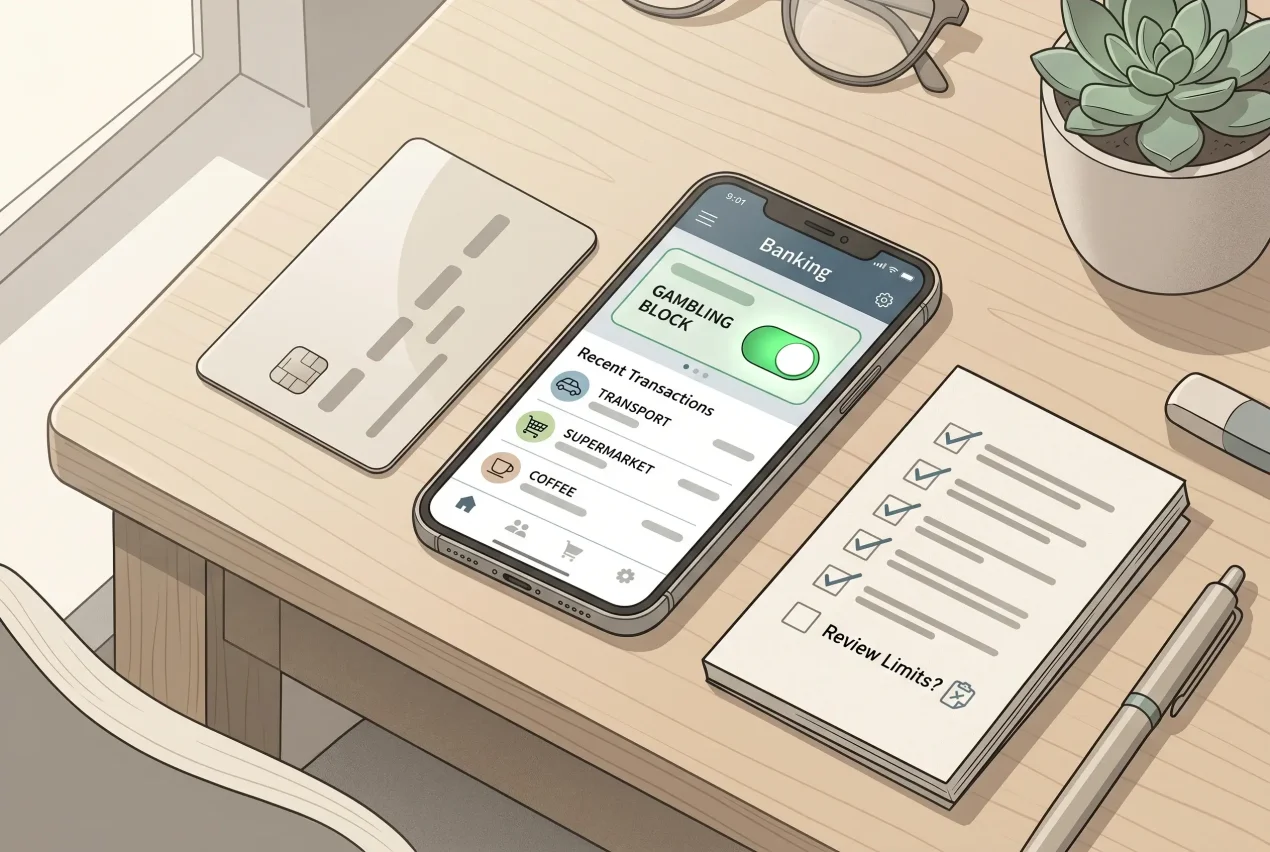
| You want a bank gambling block | Bank controls can add friction when gambling spending is becoming hard to stop. | Use your bank app settings or contact the bank. Pair the block with account limits or support if needed. |
| You think you were tricked into a bank transfer | This may be a scam or fraud concern, which is not the same as a normal lost bet. | Keep records and follow payment-fraud guidance. Do not assume a refund is available. |
Spending controls are covered in limits and account history.
Bank blocks help most when you respect the block
Many UK banks provide gambling-payment blocks or spending controls. They can be useful when you want an extra pause between an urge to gamble and the payment itself.
A bank block is not a cure, and it may not stop every possible route. The key point is the purpose: it is there to slow spending and support a boundary. If you are trying to override your own block, that is a sign to step away from payment checks and use support.
Higher-risk signals
- You are checking payment methods because a bank block stopped a deposit.
- You are borrowing, hiding transactions, or chasing losses.
- The site pushes speed before identity, licence or withdrawal checks.
More protective choices
- Keep the block in place and add clear account limits.
- Review your limits and spending records.
- Use support with gambling and debt before making another payment.
Records and next steps
Keep payment evidence, but choose the right route
Payment records matter if a deposit, withdrawal or bank transfer later becomes unclear. Keep screenshots, account messages, transaction references and the terms you relied on before paying.
Do not present a normal gambling loss as fraud. If the issue is a delayed withdrawal, unclear terms or a disputed payment handling route, move to payment-related complaints. If the issue is pressure, debt or repeated attempts to get around protections, use support first.
When payment checks become personal
If you are looking for a new payment route because gambling has become difficult to control, the safest next step is not another deposit. Review bank blocks, account limits and support options together.
The wider context is in our safety-first guide to sites outside GAMSTOP.
Related posts
Bonus terms and customer funds: checks before taking an offer
Getting help if gambling feels hard to control