
Progressive Jackpot Slots: How the Prizes Grow
 Available in GB
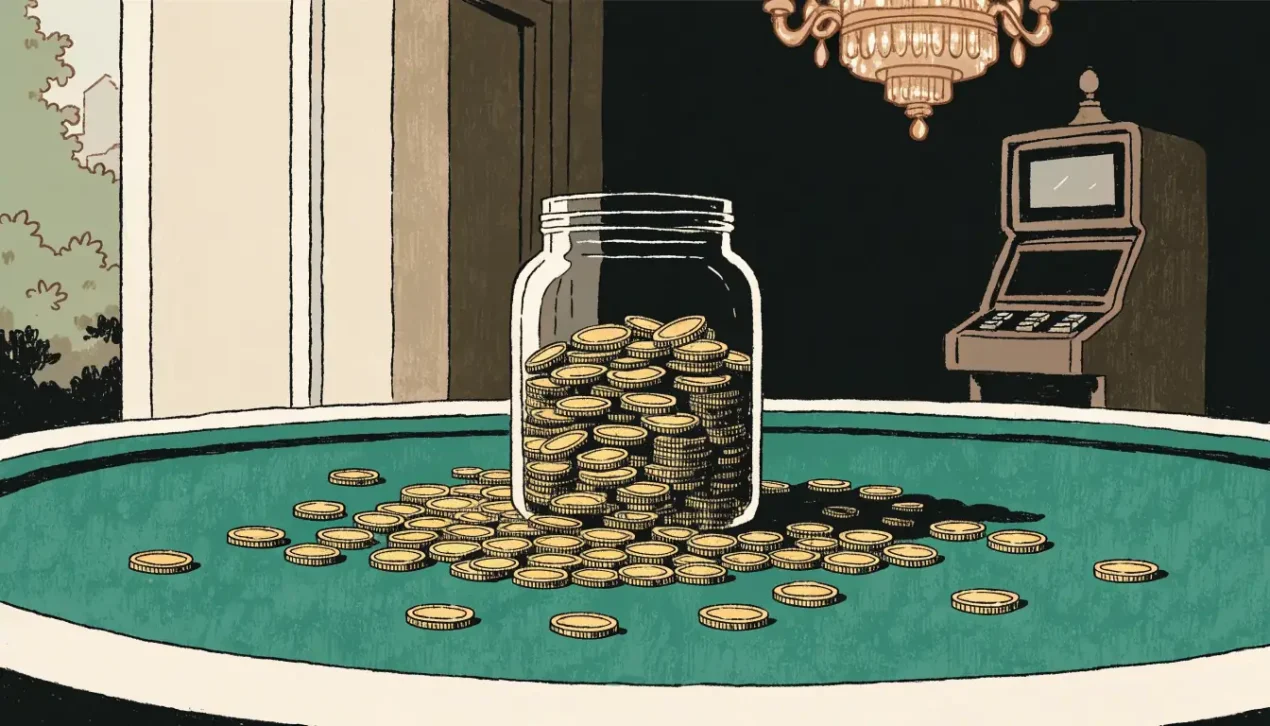
See how shared pools are funded, what it can take to qualify, and why a displayed jackpot is only part of the decision.
Where the Jackpot Money Comes From
A progressive jackpot is not a prize set aside in full before a slot begins taking wagers. Its defining feature is that the pool grows as people play. A small portion of each wager on a connected machine is added to the shared total; many small contributions, gathered across play, make the displayed prize possible.
For progressive jackpot slots, the contribution is typically between 1% and 3% of each wager. That slice is easy to overlook beside the symbols, animations and changing figures on screen. Yet it is the central piece of the arrangement: the jackpot is funded by play on machines linked to the same pool, rather than by one machine alone accumulating every contribution.
The connection matters. A progressive jackpot pool draws money from wagers placed across connected slot machines. Depending on how a particular game is set up, those machines may be found in more than one place. A person sees a game on a screen; the prize reflects contributions gathered through a wider system. The apparent intimacy of a solitary spin rests on collective participation.
That is why the number displayed beside a progressive game can keep rising even when the machine in front of someone has seen little activity. The pool is not simply a counter for that one cabinet or session. Contributions from connected play accumulate together, and the total shown represents that combined movement of money.
This funding model also distinguishes progressive jackpot casino slots from games with a fixed top prize. A fixed prize is defined in advance; a progressive one changes as eligible wagers feed the pool. Its size is therefore not an independent promise made by the graphics. It is an account of money being directed into the jackpot mechanism as play continues.
The contribution is small relative to an individual wager, but repeated across connected machines it can become substantial. The system depends on accumulation rather than on any single player supplying the whole prize. Each wager adds only a fraction, while the pool’s growth comes from the repeated contributions of many wagers over time.

There is a quiet social bargain in that design. Players provide the flow of small additions; the game presents the possibility of a much larger shared prize. The system turns ordinary play into a collective source of funding, though participants do not gather in one room or necessarily know that their wagers are linked. The network does the gathering for them.
That can make the jackpot seem almost detached from the activity that sustains it. The figure may be prominent and dramatic, while the contribution behind it is modest and easy to miss. But the two belong together. Without wagers entering the connected system, there is no continuing accumulation in the progressive pool.
Online progressive jackpot slots follow the same broad logic when their games are connected to a shared pool: qualifying wagers contribute to that pool as play takes place. The screen may make the experience look self-contained, but the jackpot’s funding is collective. Online slots with a progressive jackpot are not necessarily building a separate prize for each individual player or screen; the relevant pool can draw on contributions from connected machines.
This is also why the phrase “progressive” describes the prize’s funding, not a guarantee about its size or a prediction of what any one spin will return. The pool accumulates through wagers. It does not make an individual outcome more certain, and the changing total should not be mistaken for a measure of what a particular player is likely to receive.
In ordinary language, “slots with a progressive jackpot” can sound as though the jackpot is simply attached to a game. The more useful distinction is between the game itself and the pool behind it. A slot provides the play; the connected arrangement channels a small part of wagers into the shared prize. The mechanism is less mysterious once those two layers are separated.
The same distinction is useful when people talk about the best progressive jackpot slots or the best online progressive jackpot slots. A headline figure may attract attention, but it does not explain how that figure was funded. The underlying principle remains the same across progressive games: wagers on connected machines contribute to a pool, and those contributions build its total. A large display is the visible end of a less visible process.
Progressive jackpots are, in that sense, records of collective spending as much as features of individual games. Each contribution is slight; the accumulation is the point. The spectacle belongs to the screen. The money comes from the network.
Playing Online: Free Spins, Real Stakes and the Fine Print
A progressive slot can be opened in a free-play mode or played for real money, but the screen may make the two experiences look more alike than they are. In free play, credits are for trying the game; they are not a cash balance, and a displayed jackpot win does not become a withdrawal. The play can show how a title behaves, but it cannot reproduce the financial consequence of staking money.
Free spins sit in a different category. They are promotional plays rather than a general promise that every progressive slot can be tried without cost. Their availability and terms depend on the offer, and the game itself may be excluded. A specialist review reports that most free-spin offers are confined to non-progressive slots; where progressive play is included, winnings may be subject to a cash cap of £50–£100. That is a reported offer pattern, not a universal rule. The terms attached to a particular promotion determine what counts, which games qualify and whether a win can be withdrawn.
That distinction matters because the word “free” describes the spin, not necessarily the outcome. A promotional spin may produce a balance subject to conditions, while free-play credits have no cash value at all. Neither should be confused with a real-money jackpot win. The precise terms are less glamorous than the flashing counter, but they govern the money.

Real-money play changes the calculation at the point of the stake. A progressive jackpot slot online can show a large prize, yet the player is also putting funds at risk on each game cycle. A win is possible, not assured; a jackpot display is not a forecast of what the next spin will return. For that reason, a free demonstration can be useful for learning the layout or features, but it offers no reliable measure of what a session with money will feel like.
In Great Britain, online slots operate within specific limits. A game cycle must last at least 2.5 seconds before another can begin, and autoplay is prohibited. The maximum stake for a cycle is £2 for a customer aged 18 to 24 and £5 for someone aged 25 or over. These rules apply to online slots, including progressive titles; a jackpot label does not place a game outside them. They also mark a clear difference between a demonstration and actual play: a displayed free-play balance is not a licence to ignore the restrictions that govern real-money games.
The phrase “real money progressive jackpot slots UK” can suggest that the central decision is whether the prize is large enough to justify a spin. In practice, the conditions around play matter just as much. A real-money balance can be lost, and promotional credits can come with their own restrictions. The two kinds of play therefore answer different questions: free play lets a person inspect a game without wagering cash, while real-money play exposes a balance to the result.
Free online progressive jackpot slots are not all the same thing. A trial mode may use non-cash credits; a free-spin promotion may apply only to selected games and may limit any resulting winnings. Treating both as simply “free” obscures the difference between entertainment with no cash-out and an offer that might generate withdrawable funds under stated terms. The small print is part of the product, not an afterthought.
For a progressive jackpot online casino, the relevant detail is not merely whether a slot appears in the lobby. It is whether the game is available for free play, whether a promotional offer includes it, and what terms apply to any promotional winnings. Those are separate questions. A title visible in a free-play setting does not establish that free spins are available for it, and a free-spin offer does not establish that the jackpot itself can be won under the promotion.
The same caution applies to online casinos offering progressive jackpots: the word “online” says where the game is played, not what kind of credit is being used. Free-play credits, promotional spins and cash stakes each carry different consequences. A jackpot graphic may be identical in all three settings. The money is not.
Casino Bonuses Rarely Stretch to the Jackpot
A bonus can make a casino offer look larger than the money that can actually be withdrawn. The distinction matters especially when a progressive jackpot slot enters the picture: an advertised reward and a jackpot win belong to different parts of the terms, and the word “bonus” does not make them interchangeable.
No-deposit offers illustrate the gap. A specialist review reports wagering requirements of 40x–60x for this kind of bonus, alongside maximum withdrawal caps of £50–£100 on winnings from it. Those figures describe the terms reported by that review, not a rule shared by every casino. They are best read as a snapshot of how demanding such offers can be, rather than a promise of what a particular progressive jackpot casino will allow.

The arithmetic behind a wagering requirement is simple; its consequences are less so. The requirement sets how much qualifying play must take place before bonus-related winnings can be withdrawn. A cap, meanwhile, limits the amount payable from those winnings even if the balance has grown beyond it. Completing the required play therefore does not automatically mean the full displayed balance is available as cash. The conditions sit beside one another, not in place of one another.
That distinction can become easy to miss on a page where a promotional figure shares space with a jackpot graphic. The eye is drawn to the large prize; the small print describes the offer. Yet a bonus does not by itself establish that bonus-funded play qualifies for a progressive jackpot, or that any resulting prize would be treated like ordinary cash winnings. That depends on the casino’s published terms. A progressive jackpot casino bonus is not a separate promise with one standard set of rules.
The language of casino offers encourages a certain compression. “Bonus” sounds like a sum added to an account; in practice, it may be conditional value, subject to play requirements and a limit on withdrawal. Promotional pages often give the headline room and the restrictions less. This is not a flaw unique to gambling: retail discounts also rely on conditions. But casino offers attach those conditions to play and cash-out, so the difference between a balance and a withdrawable sum has particular weight.
For a progressive jackpot casino site, the key question is not simply whether a bonus is available. The terms need to say which games are eligible, whether bonus funds can be used on progressive slots, how any winnings are classified, and whether a separate cap applies. If those points are unclear, the offer cannot safely be treated as a route into a jackpot. It is an offer whose boundaries have not yet been established.
The same caution applies when comparing progressive jackpot casino sites in the UK. A headline bonus is a poor basis for ranking them if its qualifying games, wagering conditions or withdrawal treatment differ. “Best” in this context cannot be inferred from the largest advertised figure. A smaller offer with plainly stated conditions may be easier to assess than a more generous-looking one whose restrictions are scattered across several pages.
The no-deposit label can be especially persuasive because it suggests value without an initial payment. But “no deposit” describes how the offer is accessed; it does not remove the conditions attached to it. The specialist review’s reported wagering range and withdrawal cap make that point concrete, while also showing why those numbers should not be transferred to another operator without checking its own terms. A bonus is a contract in miniature. The headline is only its cover.
Questions about bitcoin or other crypto payments do not resolve the bonus question. A payment method and a promotion are separate matters, and the word “crypto” cannot establish whether a particular offer permits progressive play or how a win would be handled. The published terms for the specific casino and promotion are what determine that. Without them, a claim that a bitcoin progressive jackpot casino offers a more favourable bonus would be speculation, not comparison.
There is a quiet hierarchy in these promotions: the striking number attracts attention, while the conditions decide what it means. A jackpot may dominate the screen, but the bonus terms govern only the promotional value they describe. Keeping those categories separate prevents an offer from appearing to promise access, eligibility or cash that its wording may not provide.

Small print, large consequences.
Machines, Triggers and the Price of Qualifying
A progressive jackpot slot machine can make the prize depend on more than the symbols shown on its reels. The decisive event may be a random trigger, a particular combination, or entry into a bonus round. These are different routes to the same headline outcome, and the distinction matters: a jackpot that can arrive through a random event is not governed by the same visible sequence as one attached to a defined combination or feature.
With a combination-based trigger, the game presents a condition that can be recognised in its rules. A bonus-round trigger instead makes entry into that feature part of the route to the jackpot. Neither description, on its own, says how often the event occurs or how large a prize is available. It describes the door, not the odds of walking through it.
A random trigger is less legible. The jackpot may be awarded without a particular winning line announcing its arrival; the event is determined by the game rather than by a visible combination. That can make the machine feel as though it has its own private timing. It does not mean that every spin is equally likely to produce the prize, or that a player can infer a pattern from a run of ordinary results. The trigger is random, not a puzzle left for persistence to solve.
Understanding Triggers
Jackpots can be triggered by random events, specific combinations, or entering a bonus round.
There is also a price of qualifying, in some games. A specialist review reports that certain random-trigger progressives require a minimum bet for eligibility for the highest jackpot tier. That is a condition attached to particular titles, not a rule that can safely be carried over to every progressive slot. A stake below the stated threshold may leave the top tier out of reach even while the game itself remains playable.
This is where the word “progressive” can invite a mistaken assumption: that every wager on a machine has access to every prize it displays. The label describes a jackpot that grows through connected play; it does not, by itself, settle which stake qualifies for which tier or what event awards it. Those terms belong to the individual game.
The practical distinction is therefore between playing the base game and meeting the conditions for a particular jackpot. A machine may accept a stake while offering no eligibility for its highest tier at that level. Another may attach the jackpot to a combination or bonus feature. The rules are not decorative small print; they define what counts as a qualifying play.
For progressive jackpot slot machines, the game information is the place to establish the trigger and any stake condition before play begins. The wording may be less dramatic than the jackpot display, but it carries the operative detail. A bright prize meter can make the opportunity look simple. The mechanism may not be.
Games and the Shared Networks Behind Them
A progressive slot can look like a solitary machine: one title, one set of reels, one prize displayed on screen. The pool behind that prize may be less local. When operators carry the same progressive slot game, they can be connected to a shared jackpot pool. The casino window is only one entrance to a larger arrangement.

That distinction changes what “shared” means. It does not mean that every slot in every casino contributes to one universal prize. The connection described here is between operators carrying the same game. A title’s pool can therefore extend across casino sites rather than stopping at the boundaries of the site where a spin takes place. A progressive jackpot casino game may be presented in separate places while drawing on the same network pool.
The game remains the visible unit; the network is the less visible one. That matters because the name on the screen alone does not explain the reach of its jackpot. Two versions of a title may appear in different casino lobbies, but the relevant question is whether they are the same progressive game connected to the shared pool—not merely whether their artwork or theme resembles one another. Similar-looking reels are not proof of a common jackpot.
This also makes phrases such as “the biggest progressive slot jackpot” less simple than they sound. A headline prize belongs to a particular arrangement, not to a general category of games. The phrase “top progressive jackpot slot games” can suggest a stable league table, when the central point is often the network attached to each title. A progressive jackpot slot game is not defined only by its symbols or bonus round; its prize may be linked to a pool spanning operators that offer that same game.
There is a social history in this design. Casinos once made their scale visible through rooms, machines and crowds. Online, the crowd is harder to see: it may be dispersed among operators, joined not by a shared building but by a common game and its network. The display compresses that distance into a single figure. The underlying connection is less theatrical, and more consequential.
For players comparing progressive jackpot slot games in the UK, the useful distinction is not between a prize seen on one site and a prize seen on another. It is between a pool tied to one operator and a network pool shared by operators carrying the same title. The same game can be a small tile in several casino lobbies and part of one wider jackpot arrangement. The network does the joining.
UK Casinos: Licensing Before the Spin
A progressive jackpot slot may look like a small island of chance, but the casino offering it sits within a much larger system of public oversight. In Great Britain, the UK Gambling Commission is the sole regulator for commercial gambling. Its remit includes online casinos and remote gambling offered to consumers in Great Britain, even when the equipment used to run a service is located elsewhere.
That last point matters in a business built to cross borders. A website may be operated from abroad; that does not, by itself, remove the need for the relevant UK Gambling Commission licence when remote gambling is offered to people in Great Britain. The location of the servers is not the boundary of the regulator’s concern. The customer market is.
The Commission’s licensing work covers both businesses and individuals. Businesses need operating licences for the gambling activities they provide, while individuals involved in operating gambling businesses may need personal licences. The distinction reflects an old principle in regulation: responsibility belongs not only to the institution on the sign, but also to the people carrying out its work.

For someone comparing progressive jackpot casinos in the UK, licensing is therefore a more meaningful starting point than a polished lobby or a large prize display. A familiar game title does not establish that the casino carrying it is authorised to serve the British market. Nor does the word “UK” in a site’s branding settle the question. The relevant matter is whether the operator holds the appropriate current licence.
The public register maintained by the UK Gambling Commission allows an operator’s licence details to be checked before an account is funded. That is a practical distinction, not a ceremonial one: a licence identifies the regulator responsible for the business and the framework under which its commercial gambling is offered. The Commission regulates the activity; it does not certify a jackpot as a sensible financial prospect.
This is the quieter part of choosing a progressive jackpot casino in the UK. The glamour belongs to the illuminated prize counter; licensing belongs to the unglamorous question of who is accountable. In a market where remote services can be run from beyond the country’s borders, that accountability is not a detail. It is the ground beneath the screen.
A progressive jackpot slot in Britain is thus encountered through two separate systems: the game and the legal permission to offer it. The first may connect a title across operators; the second determines whether a business can lawfully provide commercial gambling to consumers in Great Britain. The Commission issues the licences. The distinction is plain.
Why the Biggest Jackpot Is Not the Whole Story
A headline prize is a striking number, but it describes only one part of a progressive slot’s payout structure. The base game has its own return-to-player figure, while a share of the payout is directed towards the jackpot. In progressive slots, that division can leave the base-game RTP in the 88%–92% range, with the difference going towards the jackpot pool.
That distinction matters when comparing games. A progressive slot jackpot may be large and still tell little about the experience of ordinary spins: the headline figure says what the pool might pay, not how the base game returns money over time. The RTP figure gives a broader mathematical view, though it is not a forecast for an individual session. Neither measure, on its own, captures the whole arrangement.
The figures also resist a simple ranking. A list of the biggest progressive slot jackpots would sort prizes by headline size, but not establish which game offers the better overall return. Nor does the label “best progressive jackpot slot” have a single mathematical answer. A player interested in the possible top prize is looking at a different feature from someone comparing the base-game return. Both are legitimate measures; they are not interchangeable.
This is the quiet bargain built into the format. The jackpot gives the game a visible point of anticipation, while the base-game RTP reflects a separate part of its payout design. When the return allocated to the jackpot is larger, the base-game figure can be lower. The spectacle and the underlying arithmetic sit side by side, but they do not say the same thing.
A large prize can therefore dominate the conversation without describing the full payout picture. The largest progressive jackpot slots UK players can find are not necessarily the ones with the highest base-game RTP, and a higher RTP would not by itself identify the most appealing jackpot structure. Those are different comparisons, requiring different information.
Numbers have their own stagecraft. The jackpot is the bright lettering; RTP is the smaller print beneath it. Neither makes the other irrelevant, but only one is designed to catch the eye.
Availability Changes from Casino to Casino
A progressive jackpot slot can be familiar by name and still be absent from a particular casino’s games page. There is no single UK-wide catalogue: operators carry different selections, and those selections change as game providers update their catalogues. A specialist review reports this variation, but a review is a snapshot, not a permanent inventory.
That matters when a game has a strong reputation or a prize that attracts attention. Popularity does not make a title universal, and a high rating does not mean every casino site with progressive jackpot slots will offer it. The list visible at one operator may differ from another’s, even when both have a substantial selection of video slots.
“Biggest” can also mislead as a way of choosing where to look. A headline prize may draw the eye, but it does not establish that the game is currently available at a particular casino. Availability is a catalogue question, not a verdict on quality. The machinery of modern distribution has made games easier to circulate across many sites; it has not made every operator’s shelf identical.
A casino’s catalogue should therefore be treated as something that moves, not as a fixed promise attached to its name. Providers update what they supply, and operators’ collections change in turn. A title found during one visit may not appear in a later catalogue, while another operator may carry it. The exact position can only be established from the game listings an operator currently publishes.
This is a modest distinction, but an important one. “Top-rated progressive jackpot slots” describes an evaluation; “available here” describes an inventory. The two may overlap, but neither guarantees the other. A popular progressive slot in Britain is not necessarily present at every site, and a casino’s range can change without its identity changing at all. A catalogue is not a constitution.
Mega Moolah in the Progressive Jackpot Conversation
Mega Moolah is a name that appears in discussions of progressive jackpot slots, but the label alone does not establish the prize currently attached to a game, where it is available, or the terms under which it can be played. Those details depend on the game and the operator carrying it. A name can travel further than its live availability.
The useful point is what “progressive” means. Unlike a fixed prize, a progressive jackpot is funded as wagers are placed on connected slot machines. A portion of each stake is directed into the shared prize pool; across progressive slots, that contribution is typically between 1% and 3% of each wager. The exact contribution for a particular title should not be inferred from the category-wide range.
That distinction matters when a title is discussed as a progressive jackpot slot in the UK or online. The phrase describes a jackpot structure, not a promise that a particular prize is available at every casino, or that every spin qualifies for it on identical terms. The name is not the mechanism.
Nor does a demo version, where one is offered, tell the whole story about real-money play. A demonstration can illustrate a game’s format, but it does not show that a real-money jackpot pool is being funded by those practice spins. The progressive label concerns how the prize is built in qualifying play, not simply the appearance of a growing figure on a screen.
“Progressive diamond jackpot” is another phrase that may suggest a specific prize tier or visual theme. Without game-specific terms, the wording alone cannot confirm either. The same restraint applies to claims about a jackpot’s current size or a title’s availability: those can change, and a label is not a live catalogue.
The appeal of Mega Moolah in this conversation is therefore best understood through the broader idea of a progressive pool. Each qualifying wager contributes a small share; the accumulated prize gives the game its progressive character. The name supplies recognition. The rules supply the meaning.
Top online casinos in the UK
- SpinFormulaBonus: 550% Up To £15,000 + 550 FS · Payout speed: 1-3 business days
- SlotoSportBonus: 500% up to £ 10 200+ 777 FS · Payout speed: 1-3 business days
- Revery PlayBonus: 100% up to€1,000+ 100 FS · Payout speed: 1-3 business days
- AmunbetBonus: Join now and get 450% up to 2,700 GBP + 450 FS · Payout speed: 1-3 business days
- BeOnBetBonus: 100% up to €500 + 100 FS · Payout speed: 1-3 business days
- JetsetspinsBonus: 200% Bonus + 100 Free Spins + Free Royal Wheel · Payout speed: 1-3 business days
- NightWinBonus: £900 + 400 free spins · Payout speed: 1-3 business days
- x3betBonus: Welcome Pack 100% Up to £1.000 + 200 Free Spins · Payout speed: 1-3 business days
- ZombillionBonus: Welcome Pack 250% up to £4000 + 200 FS · Payout speed: 1-3 business days
- BritsinoBonus: Welcome Package – Get your £2,200 + 2,000 FS · Payout speed: 1-3 business days
When a Progressive Win Becomes a Withdrawal
A progressive jackpot win does not necessarily arrive in a bank account at the moment it appears on screen. The operator may first need to confirm the win and complete checks before releasing the funds. For a substantial prize, the route from game balance to spendable money can involve more than a routine withdrawal request.
A specialist gambling review gives a sense of how payment methods can differ: debit-card withdrawals are reported at one to three working days, e-wallet payments may take hours, while bank transfers are described as taking three to five working days or longer. These are reported timeframes, not a promise attached to every casino. Processing can depend on the operator and the payment method, and the time shown in an account may not include any checks needed before payment is approved.
Large wins can bring additional identity or account verification. A specialist review also reports that some large progressive prizes may be paid in structured instalments over several years rather than as one immediate transfer. The arrangement matters: a displayed jackpot figure and the amount available at once are not necessarily the same thing.
For anyone playing progressive jackpot slots for real money, the withdrawal terms are therefore part of the practical value of a win. The payment page and the game’s rules should explain how the operator handles large prizes, what checks may apply and whether payment can be staged. If the terms are unclear, the operator’s customer service can clarify them before a withdrawal is requested.
The distinction is unglamorous but decisive. A jackpot can be won in a moment; receiving it may be a process.
Do all UK casinos offer the same progressive jackpot games?
No. Availability varies by operator and changes as game providers update their catalogues, although a network jackpot can be shared across operators that offer the same game.
How fast are progressive jackpot withdrawals paid out?
E-wallet withdrawals can take hours, debit card withdrawals typically take 1–3 working days, and bank transfers often take 3–5 working days or longer. Large jackpot wins may need extra verification and can be paid in structured instalments over several years.
What should I look for in a progressive jackpot slot?
Check the game’s RTP, how the jackpot is triggered, and whether a minimum bet is needed to qualify for the highest jackpot tier. Also check the game’s rules for how its jackpot works.
Can you win a progressive jackpot on a minimum bet?
Some games require a minimum bet to qualify for the highest jackpot tier. Check the game rules to see whether the minimum stake qualifies for the jackpot you are targeting.
Related posts

UK Casino Welcome Bonuses: How Offers Work

VPN-Friendly Casinos in the UK: How Access Works
