
Live Casino UK: How Tables and Rules Work
 Available in GB
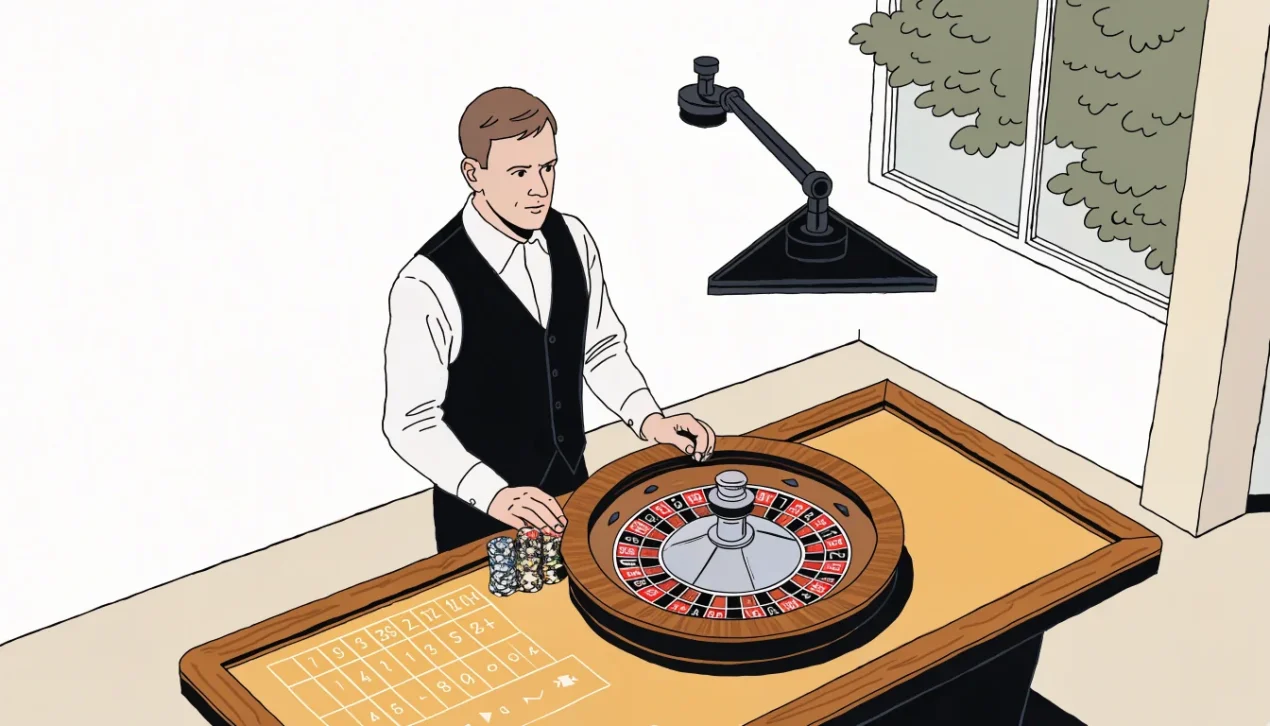
A guide to how live games work, from placing bets through a screen to the terms that can affect real-money play.
Live Play Online, and the Rules Behind the Screen
A live casino table is both a room and an interface. A camera carries the dealer’s movements to a screen; buttons and betting fields let players place wagers within the same digital session. The cards are physical, the wheel turns in front of a lens, and the choices are made through software. The format borrows the ceremony of a casino floor while removing the floor itself.
That distinction matters. In a conventional digital casino game, the action is generated on screen. In a live game, a dealer handles the equipment in a studio or other broadcast setting, while software transmits the image and records players’ selections. A player may see the dealer, the table and other visual details, but does not take part in the room as a visitor would. The screen offers presence, not proximity.
The betting interface is the other half of the arrangement. It gives each player a place to make a selection, shows when betting is open and closes that window before the dealer continues. The video and the controls have to remain in step: a stream that lags behind the betting state would turn a social-looking game into a confusing one. Even where the dealer’s gestures are familiar, the online version depends on software to connect the broadcast with the decisions entered remotely.
This is why live play is not simply a camera pointed at a table. It is a designed sequence: the dealer presents the action, the interface accepts choices, and the round proceeds once the relevant window has closed. The player watches from outside the room, but the system must make the timing legible. The table’s rituals survive; the means of joining them have changed.
There is a small social fiction in the arrangement. A dealer may address the camera as if speaking to a room, while each participant remains alone with a device and a set of on-screen controls. The format offers a shared focal point, not necessarily a shared social space. Its appeal lies partly in that compromise: human gestures provide continuity, while the interface makes distance manageable.

The legal setting is less theatrical. In Great Britain, remote gambling offered to consumers falls under the remit of the UK Gambling Commission even when the equipment running the service is located elsewhere. A streamed table does not become exempt from regulation because its cameras, dealers or technical systems sit beyond the country’s borders. The location of the machinery does not settle the question of which rules apply to gambling offered to people in Great Britain.
That principle reflects the nature of remote play. A service can be physically distant and still be directed at a local market. Regulation follows the offer to consumers, rather than stopping at the studio door. For live casino play, the broadcast is only one visible part of a larger arrangement; the legal framework concerns the gambling activity delivered through it.
The distinction between a live table and a digital interface therefore has two sides. Technically, they work together: one supplies the observed event, the other makes participation possible. Legally, the stream’s physical location does not remove the activity from British oversight. What appears on screen may look like a room elsewhere, but the service is still remote gambling when offered to consumers in Great Britain.
The format also changes the rhythm of attention. A physical dealer’s movements create pauses that a purely digital game might not need, while the interface makes each player’s action explicit. The camera can show a card being dealt; it cannot show what a participant intends to do until that choice is entered. The screen makes the table visible and the player’s decision legible to the system. That is its quiet bargain.
The room is remote; the rules are not. In Great Britain, online gambling is legal only through sites holding a UK Gambling Commission licence, and the law permits play for adults aged eighteen and over. The regulator’s reach over remote gambling offered to British consumers does not depend on where the key equipment is housed. A live casino may be staged elsewhere, but its online offer to this market remains within the British regulatory frame.
That frame is a condition of the format, not a feature added to the broadcast. A polished image can make a table feel immediate; it cannot, by itself, establish the legal standing of the service behind it. The streamed dealer and digital controls explain how the game is played. Regulation explains the terms on which it may be offered in Great Britain.
The screen gives distance a human face. The law keeps its own address.
Top online casinos in the UK
- SpinFormulaBonus: 550% Up To £15,000 + 550 FS · Payout speed: 1-3 business days
- SlotoSportBonus: 500% up to £ 10 200+ 777 FS · Payout speed: 1-3 business days
- Revery PlayBonus: 100% up to€1,000+ 100 FS · Payout speed: 1-3 business days
- AmunbetBonus: Join now and get 450% up to 2,700 GBP + 450 FS · Payout speed: 1-3 business days
- BeOnBetBonus: 100% up to €500 + 100 FS · Payout speed: 1-3 business days
- JetsetspinsBonus: 200% Bonus + 100 Free Spins + Free Royal Wheel · Payout speed: 1-3 business days
- NightWinBonus: £900 + 400 free spins · Payout speed: 1-3 business days
- x3betBonus: Welcome Pack 100% Up to £1.000 + 200 Free Spins · Payout speed: 1-3 business days
- ZombillionBonus: Welcome Pack 250% up to £4000 + 200 FS · Payout speed: 1-3 business days
- BritsinoBonus: Welcome Package – Get your £2,200 + 2,000 FS · Payout speed: 1-3 business days
What a UK Live Casino Site Must Get Right
A live casino site is more than a camera pointed at a table. It is the business arranging access to gambling: the account, the rules for participation, the handling of bets and the route by which a customer can raise a complaint. The streamed dealer may give the experience its familiar human face, but the operator sits behind the whole arrangement. That distinction matters. A convincing studio is not, by itself, evidence that the business is entitled to offer gambling in Great Britain.
The phrase “live casino” describes a format, not a regulatory category that excuses the operator from ordinary obligations. A site may bring live-dealer tables into a wider online casino, but the customer is still engaging with a gambling business through an account and a digital interface. The atmosphere is designed to suggest a public room; the relationship is private and contractual. The operator determines the terms under which that relationship exists.

In Great Britain, commercial gambling is overseen by the UK Gambling Commission. Its remit includes online casinos, and it is the regulator responsible for commercial gambling in Great Britain. The Commission grants operating licences to businesses and personal licences to individuals working in relevant roles. These are not interchangeable permissions: a business licence concerns the organisation offering gambling, while a personal licence concerns an individual operating within the regulated industry.
That division is easy to overlook when the visible part of a live table is a dealer, a studio and a sequence of bets. Yet the person on screen is not the business accepting the wager. The operator remains responsible for offering the service under the appropriate regulatory framework. A dealer’s professionalism, a carefully lit set or an uninterrupted stream may improve presentation; none answers the more basic question of who is providing the gambling and under what authority.
The legal boundary is consequential. Remote gambling offered to consumers in Great Britain requires the relevant Gambling Commission licence, whatever the location of the equipment used to run the service. A company does not avoid the requirement simply by locating its servers, studio or offices elsewhere. The licensing question attaches to the activity offered to people in Great Britain, not to the geography suggested by a distant production set.
For England, Wales and Scotland, the Gambling Act 2005 provides the principal statutory framework. Northern Ireland is not covered by that Act, so “UK” can blur a legal distinction that the map makes look simpler than it is. In ordinary discussion, British and UK gambling rules are often treated as one subject; in law, the jurisdictions do not line up perfectly. The Commission’s role as the sole regulator for commercial gambling applies to Great Britain, rather than erasing that difference.
DO
- Check the operator’s regulatory status
- Identify the legal entity behind the brand
- Verify the current authorisation
DON’T
- Assume a brand name implies a valid licence
- Rely on decorative details for assessment
- Ignore the legal entity in the terms
A site’s regulatory status therefore belongs at the beginning of any assessment, not among decorative details at the bottom of a page. A familiar brand name may not make the operating company obvious. A website can present a trading name, while the legal entity responsible for the service is identified elsewhere in its terms or licensing information. The relevant question is not whether the site looks established, but whether the business behind it holds the current authorisation required to serve the market.
This is one reason that regulatory information should be read as information about an operator, rather than as a general seal of quality for every aspect of a website. A licence establishes the operator’s place within the local regulatory system; it does not turn every game, interface or customer interaction into a guarantee of satisfaction. Those are separate matters. The licence is a threshold, not a testimonial.
The reverse is equally important. A business may display polished branding, detailed game pages and a studio that appears to belong to a large international operation. Such details do not replace local authorisation. Nor does the presence of a game supplier, a payment option or a recognisable dealer establish that the operator itself is licensed to offer gambling in Great Britain. The business taking responsibility for the service is the object of the check.
That is why the identity of the operator should be traceable through the site’s legal information. The terms should identify the business responsible for the account and explain the framework under which it operates. Licensing claims should be considered in relation to that entity, rather than accepted as a general impression created by a logo or a line of promotional copy. A licence number without a clear link to the company can be less informative than it first appears.

The distinction between operating and personal licences also helps explain why several names can appear around one table. A business may provide the gambling service while individuals and technical partners perform other functions. The existence of licensed individuals in the industry does not transfer their status to a separate operator. In the same way, the supplier of a stream or game does not become the party responsible for the customer’s account merely by appearing in the production chain.
For a customer, the operator’s responsibilities are most visible when something goes wrong: an account needs attention, a decision is disputed, or identity checks affect access to funds. Withdrawals can be restricted while KYC verification is under way. That practical interruption is not a detail of the table’s presentation; it belongs to the relationship between customer and operator. The site’s rules should make clear who handles such matters and how the business can be contacted.
Age verification is another obligation that belongs to the operator, not to the dealer or the software. A gambling business must verify a customer’s age before allowing deposits into a gambling account. The sequence matters: an account interface may make registration appear effortless, but access to depositing is subject to a safeguard with a clear purpose. Commercial convenience is not the governing principle.
A sound assessment of a live casino site, then, begins with the business behind the screen. The stream may be the most conspicuous feature, but regulatory status, identifiable responsibility and clear operating terms are the less theatrical foundations. The legal framework asks who offers the gambling and whether that business is authorised to do so in Great Britain. The camera answers a different question: what the table looks like. One is not a substitute for the other.
Gambling also remains gambling when the setting resembles a studio rather than a gaming floor. Money can be lost, and the social polish of live presentation does not soften that fact. Players should wager only money they can afford to lose, set a budget and avoid chasing losses. It is a modest safeguard, and a more useful one than mistaking atmosphere for oversight.
Real-Money Play and the Limits of a Deposit
A live table can be watched without placing a cash stake, where a site offers a free-play mode, or entered with money that can be lost. The distinction is not in the dealer’s gestures or the camera angle. It is in what the betting interface accepts and what follows from a result: in real-money play, a losing wager reduces the player’s balance, while a winning one may add to it under the game’s rules.
Free play can show how a table is laid out and how its controls respond, but it does not reproduce the financial consequence of a real wager. Nor should a practice balance be mistaken for cash available to withdraw. The terms attached to a particular mode matter, and free-play access is not necessarily offered for every game. A live casino’s glass and felt may look much the same either way. The stakes do not.
For real-money live casino play, funds have to enter a gambling account before they can be used to wager. That step is more consequential than the theatrical language of a “seat at the table” suggests: a deposit is money placed within reach of gambling, not a promise of entertainment at no cost. It can be lost. Players should wager only money they can afford to lose, set a budget before play, and avoid chasing losses. A table does not recognise a previous loss as a debt it owes to anyone.

Payment rules also shape the boundary between ordinary spending and gambling. UK gambling regulations prohibit using credit cards for gambling. The restriction applies to the source of funds, not to the game being played: a live dealer table does not make a prohibited payment permissible by being streamed from a studio. Payment options and account procedures differ between operators, so the cashier and its stated conditions need to be read rather than inferred from the presence of a familiar logo elsewhere.
Age checks belong at the point where money is about to enter play. Operators must verify a customer’s age before allowing funds to be deposited into a gambling account. Verification can also affect access to withdrawals: funds may be restricted while identity checks, commonly described as KYC verification, are under way. This is a practical distinction between seeing a balance displayed and being able to move money out of an account. A deposit should not be treated as instantly reversible.
The same care applies when an account is opened on a phone or computer that may be visible to other people. Live streams can make play feel social, but a shared screen can also expose account details or other personal information. Personal information should not be shown when screen-sharing. The dealer is on camera; the player’s private account need not be.
A live casino for real money is therefore not simply a free demonstration with a payment button added. It joins a game interface to an account holding funds, under rules that govern who may deposit and how gambling may be paid for. That arrangement can feel casual because the table is immediate and the dealer is visible. The money is less theatrical. It leaves an account, enters a wager, and may not come back.
A deposit also sets a natural point at which to pause. Once funds are available, the pace of play can encourage another wager to seem like a small continuation of the last. A budget makes the boundary visible before that momentum takes over; chasing losses erases it. Neither the animation of chips nor the friendly address of a live dealer changes the arithmetic of risking money.
The useful distinction is plain: free play is a way to encounter a game without staking cash, when that mode is available; real-money play means accepting that a wager can be lost. The rules on funding and verification are part of that difference, not fine print surrounding it. A streamed table may soften the distance between home and casino. It cannot soften the consequence of the stake.
The Live Lobby: Games, Tables and the Slot Boundary
A live lobby is less a single game room than a changing catalogue. Its tables may include familiar casino games such as roulette and blackjack, alongside other card games or studio formats built around a host and a wheel. The exact mix depends on the operator and can change: a title visible in an old review, or on another account, is no guarantee that it appears in the current lobby. Availability should be checked there.

That distinction matters because “live” describes how a game is presented, not a promise about every title a casino offers. A live table brings a real-time studio or venue feed together with an interface for placing bets; a digital game may instead be generated by software. The lobby can place these formats side by side, making them look like one seamless menu. Their regulatory treatment is not necessarily the same.
The clearest boundary is between online slots and table games. A specialist review describes the Great Britain limit for online slot stakes as £5 per game cycle for customers aged 25 and over. That limit concerns slots: it does not apply to roulette or blackjack. The distinction is about the category of game, not whether a game appears on a screen, uses a digital interface or sits beside a slot in the same lobby.
A table game does not become a slot merely because the betting takes place online. Roulette remains roulette; blackjack remains blackjack. Conversely, the presence of a dealer on screen does not by itself determine whether a product is legally a slot. The relevant question is what kind of game is being offered. A lobby is a convenient display, not a rulebook.
Live versions may also differ in pace and presentation. Some are arranged around a shared table, others around a studio-hosted format; the controls, betting options and available stakes depend on the particular game. Those details are worth checking in the current lobby before play, rather than inferred from a thumbnail or a general description. Names and categories can be tidied for display. The game itself is less obliging.
Lobby Availability
Availability of specific games and modes can change depending on the operator and the current lobby.
Free access is another matter of availability. A casino may offer a way to explore a game without wagering, but that should not be assumed for every live table. Where a free mode exists, it is distinct from placing a real-money bet; it does not establish that the same title or conditions will be available for paid play.
The range can make a lobby feel like an invitation to keep browsing. A steadier approach is to set a budget in advance, avoid chasing losses and wager only money that can be afforded to lose. That is not a feature of the interface. It is the part the interface cannot supply.
Blackjack at the Table: Bets, Decisions and Etiquette
Live blackjack turns a familiar card game into a sequence of short decisions made against a clock. A player places a wager before the betting window closes, then chooses whether to hit or stand as the hand develops. The interface records the choice; the table moves on. There is little room for deliberation once a round is under way.
The central risk is plain. If a hand goes over 21, it busts and the wager is lost. If the player and dealer finish level, the hand is a tie and the original bet is returned. Neither result needs elaborate interpretation. The tension lies in deciding whether another card improves a hand or carries it past the boundary.
Insurance is a separate wager, not a way to insure the original stake against any bad outcome. It may be offered when the dealer’s second card is an Ace, and costs half the initial bet. Its presence adds another decision to a game already organised around quick choices; the table rules should be read before the first hand, rather than inferred while the timer runs.

A specialist review reports live tables with fifteen seconds for placing wagers and twelve seconds for hit-or-stand decisions. These are reported timings, not a promise about every table: the live lobby and table interface determine the pace in practice. A specialist review also gives a common range of £5 to £5,000 between minimum and maximum bets, but limits vary by table. The displayed figures matter more than a general description of what is typical.
Etiquette in a live blackjack room is mostly practical. Bets belong within the open betting window, decisions should be made before the interface closes, and chat should not interrupt the round. When sharing a screen during a live stream, personal information should stay out of view. The camera makes a social setting of what is still a gambling transaction.
The game’s rhythm can make small decisions feel weightless, especially when another hand is already beginning. They are not. A budget set in advance, and a refusal to chase losses, are more useful than trying to recover a previous result through a larger wager. Only money affordable to lose should be put at risk. A tidy table does not change the arithmetic.
Dealers, Providers and the Machinery of a Live Table
A live table is a small broadcast operation arranged around a gambling interface. The dealer handles cards, wheels or other physical equipment; cameras show the action, while software carries the image to players and records their selections. The interface is not merely a picture of a table. It must keep the stream, the betting window and the game result in step, so that a wager is accepted before the relevant action and settled afterwards.
The dealer’s work is both practical and performative. A hand is dealt, a roulette wheel is spun, a result is announced; meanwhile, the person on screen keeps the proceedings legible for people watching through a device rather than standing beside the table. There is a social quality to that arrangement, though it is carefully bounded. The dealer may acknowledge the room or explain what is happening, but does not set the game’s rules or decide how a customer’s account is treated. Those responsibilities belong elsewhere.
Behind the visible table sits a provider: a company supplying the game software and, in live formats, the systems that connect the studio, stream and player interface. Names such as Evolution and Pragmatic Play are familiar in the wider provider landscape. A provider may supply games to multiple operators, while an operator decides which products to put in its lobby and manages the customer account. The exact games and tables available can change; a familiar provider name is not confirmation that a particular live table is currently offered.
This division of labour matters. The dealer makes the table human-facing; the provider builds and maintains the machinery that makes the table playable; the operator offers the service to customers. A polished broadcast can show competent production, clear images and a smoothly functioning interface. It cannot, by itself, establish that the operator is authorised to serve people in Great Britain. Production quality and legal standing are different questions. One is visible in the stream; the other is found in the relevant regulatory record.

In Great Britain, remote gambling operators serving customers must hold the appropriate UK Gambling Commission licence, regardless of where their key equipment is located. The Commission regulates commercial gambling in Great Britain; a licence held by a studio, software supplier or overseas company does not substitute for the operating licence required of the business taking bets. Nor does a dealer’s uniform, a studio logo or a provider’s reputation prove that the operator behind the account is licensed. A camera can make a room look reassuring. It cannot issue a licence.
A specialist review reported that the Curaçao Gaming Authority listed Usoftgaming N.V. with an active business-to-consumer licence, identified as CGA/2025/1353/1345. The same review said it found no operating-licence entry for Usoftgaming N.V. or Hustles Casino in the Gambling Commission register it checked on 25 September 2026. These are separate regulatory records, not interchangeable stamps. A Curaçao licence does not amount to a UK Gambling Commission licence, and the latter is the relevant operating authorisation for gambling offered to consumers in Great Britain. Register information can change, so any assessment of an operator’s present status belongs against the current Commission record.
The machinery of play also has ordinary limits that are easy to overlook when the screen feels immediate. Table rules and interfaces may differ, and the operator controls the account, including verification. Operators must verify a customer’s age before allowing deposits. Withdrawals can be restricted while identity checks are underway; a fast-moving stream does not make those checks disappear. If a live session is shared or streamed, account details and other personal information should remain outside the frame.
The human presence can make online gambling feel less abstract than a row of buttons. It is still gambling, conducted through a commercial service. Money at the table should be money a player can afford to lose; a budget should be set in advance, and losses should not be chased. A dealer can keep the game moving. Nothing in the studio can make a loss less real.

Welcome Bonuses, Wagering and the Table-Game Catch
A live casino bonus can look generous before wagering requirements are counted. These conditions specify how much must be bet before bonus funds, or winnings linked to them, can be withdrawn. A specialist review’s worked example makes the arithmetic plain: a £100 bonus with a 35x wagering requirement calls for £3,500 in bets before cashing out. The bonus is not £100 of ready cash. It is an offer with a route attached.
The route matters especially at live tables. Operators may give blackjack, roulette and other table games a lower contribution towards wagering than eligible slots, or exclude them altogether. That can make a welcome offer poor value for someone who mainly plays live casino games: the same amount of play may clear less of the requirement. When using a welcome bonus, focus only on slots with a 100% contribution rate, and confirm that the specific games qualify. Contributions and eligibility can differ by promotion and may change.
A specialist review describes minimum deposits for welcome-offer stages in the £10–£20 range. That is an indication, not a promise that every offer or account uses those thresholds. A separate specialist review notes that free-spins winnings may be capped and may carry their own wagering requirements. The headline reward can therefore be only the first line of the terms.
Before opting in, check the current promotions page and read the full bonus terms, including wagering conditions, eligible games, contribution rates, expiry conditions and any cap on winnings. Bonus terms, wagering requirements and game eligibility are subject to change; eligibility and value may also vary between UK accounts. A bonus code does not remove those conditions.

The arithmetic is less flattering up close. Set a budget before play, wager only money that can be afforded to lose, and do not chase losses to complete a requirement. Withdrawals can also be restricted while identity checks are underway. A promotion should not turn a chosen table into an obligation.
Live Casino Offers: Value Depends on the Small Print
A live casino offer can look generous in its headline and modest in its usable value. Sign-up promotions differ in structure, and the same offer may not be available on identical terms to every UK account. A list of “best” deals would therefore age quickly; the promotion page in force at the time of registration is the meaningful starting point.
The arithmetic matters more than the advertised bonus. One specialist review describes a £100 bonus with a 35x wagering requirement: £3,500 in bets would be needed before cashing out. That is an illustration, not a standing market rule. Free-spins winnings may also be capped and subject to wagering requirements, so the displayed prize and the amount ultimately withdrawable are not necessarily the same thing.

Game contribution can change the calculation. Live tables and other table games may count at a reduced rate, or be excluded, making a welcome bonus less useful to someone who mainly wants live play. When using a welcome bonus, focus only on slots with a 100% contribution rate, and check the eligible-game list rather than assuming every title counts equally. Poker availability and promotion eligibility should likewise be confirmed in the current lobby and terms; a casino label alone settles neither.
Bonus terms, wagering requirements and game eligibility can change. Read the full promotion terms before opting in, and check the current promotions page: eligibility and value may vary between UK accounts. Set a budget, avoid chasing losses, and wager only money that can be afforded to lose. Withdrawals may also be restricted while identity checks are under way.
Small print, large consequences.
Related posts

UK Casino Welcome Bonuses: How Offers Work

VPN-Friendly Casinos in the UK: How Access Works
